ROCCO PRIOLETTI
Staff Writer
“These two masterpieces complement one another beautifully,” Rossen Milanov, Chautauqua Symphony Orchestra’s music director, said ahead of the CSO’s exploration into the mind of German composer Richard Strauss.
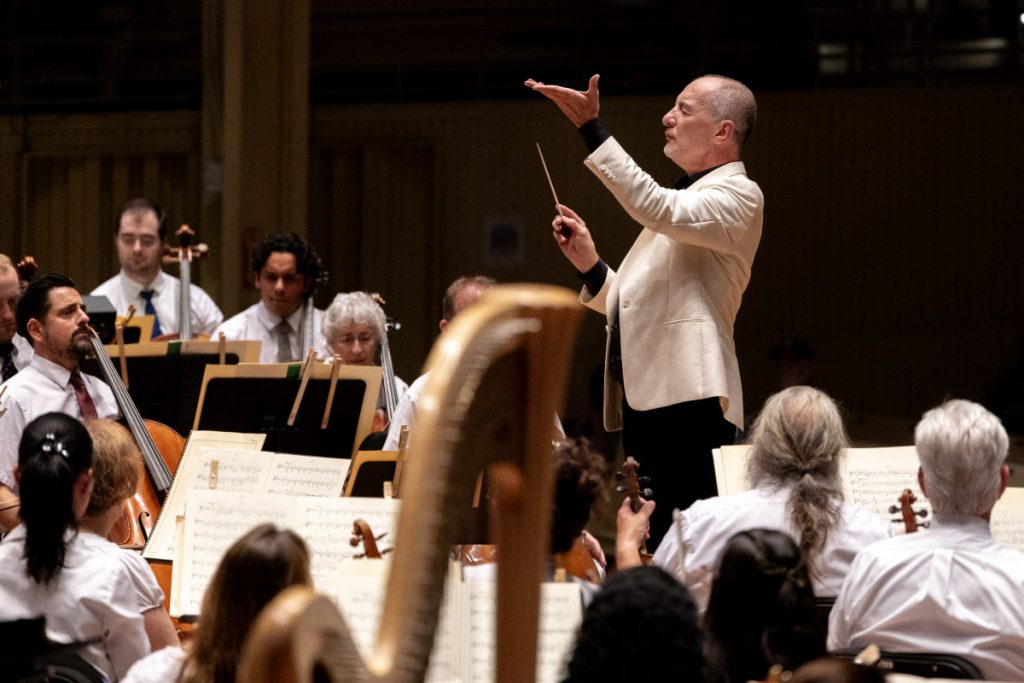
At 8 p.m. this evening in the Amphitheater, Milanov will conduct the CSO beyond life and death in their program, “Sounds of Strauss.”
“Also sprach Zarathustra,” Op. 30, invites audiences in with an instantly recognizable theme by way of its appearance in Stanley Kubrick’s film “2001: A Space Odyssey.” Accompanied musically by the film’s iconic sunrise imagery, Milanov stated that Strauss’ initial depiction of this image in his tone poem is representative of human consciousness awakening.
“Throughout the work, he contrasts humanity’s search for certainty with the mysteries of existence,” Milanov said. “The music moves through moments of triumph, humor, sensuality, dance and profound introspection.”
Milanov noted the curiosity behind the piece’s enigmatic ending, as Strauss left the final movement unresolved between two keys.
“It’s as if he is telling us that the deepest questions about existence cannot be answered definitively. The search itself is what matters,” Milanov said.
Contextualized within the program, this refusal of a cohesive resolution remains lingering throughout the subsequent piece, “Death and Transfiguration,” Op. 24, where the search for the unanswerable continues even after the eyelids close one last time. By its end, though, a conclusion is ultimately discovered through imagination.
“Death and Transfiguration” will conclude the evening performance by encapsulating the fleeting flash-before-your-eyes moments of a dying artist’s life. This is a feeling that Strauss, as he himself was dying, attested to the accuracy of his prior compositional rendering.
“The work unfolds almost like a psychological drama. It begins with the labored heartbeat and breathing of a dying man. Memories of childhood and youth emerge, followed by struggles, disappointments and the lifelong pursuit of an unattainable artistic ideal,” Milanov said.
After Strauss’ musical death, the tone poem’s namesake of “Transfiguration” is depicted not via religious revelation, but rather as “the moment when the artist finally attains, beyond earthly life, the perfection that remained forever out of reach while living,” according to Milanov.
In both pieces, Strauss grasped at humanity’s ability, or lack thereof, to understand subjects fundamentally out of one’s reach. Whether this manifested intimately through the death of the self or broadly via questions of humanity’s cosmic function, Strauss’ philosophical fascinations lie in an unmarked path beyond the unknowing.
“Even though one work ends with a vision of fulfillment and the other with an unresolved question, both suggest that life’s greatest meaning lies not in easy answers, but in the courage to seek something beyond ourselves,” Milanov said.