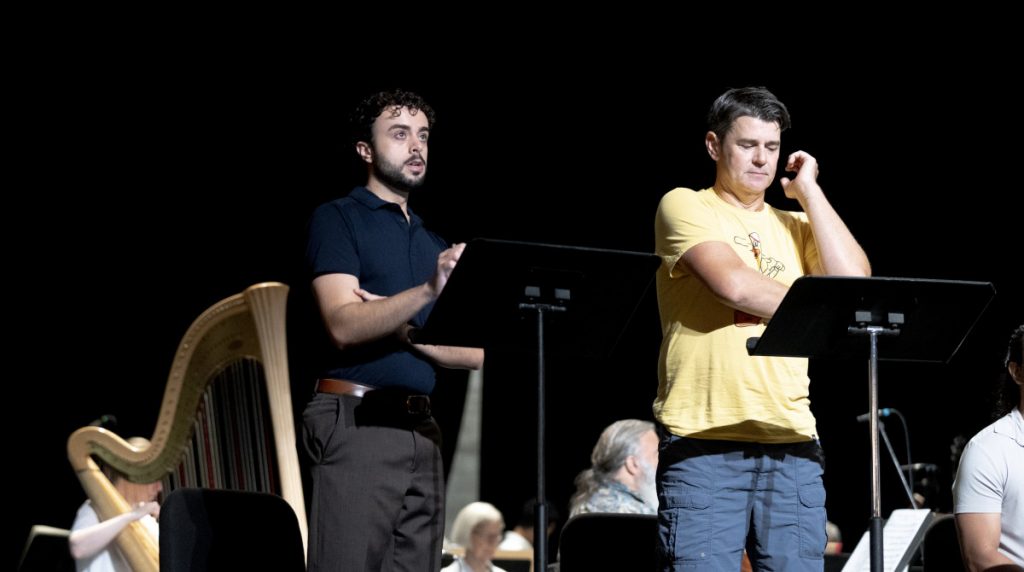
Chautauqua Opera Company Apprentice Artist Joel Clemens, baritone, and Guest Artist Keith Phares, baritone, rehearse for Rosencrantz and Guildenstern Are Dead Monday in Norton Hall.
LAYLA VINSON
Staff Writer
Closing the curtain on the 2026 Summer Season with an iconic piece of American theater, Chautauqua Opera Company will showcase its final presentation of Tom Stoppard’s Rosencrantz and Guildenstern Are Dead workshop at 3:15 p.m. today in Norton Hall. Brought to Chautauqua by two-time Grammy Award winner Herschel Garfein, the work marks the first-ever operatic adaptation of the story in an especially poignant milestone months after Stoppard’s passing.
“The main thing [Stoppard] said to me was, ‘It has to be funny.’ And I’ve taken those words to heart, and through all the years that I’ve worked on this, that has been my main goal,” Garfein said. “… I do think that Stoppard is like the Oscar Wilde of our times, and only he could put together ideas like that in such a witty, epigrammatic form. I love that about him. Hopefully, audiences will find a lot to love and a lot to laugh at in what they hear.”
Centered on two of the smallest characters from Shakespeare’s Hamlet — Rosencrantz and Guildenstern — Stoppard’s story focuses on the reluctant pair of philosophers struggling to make sense of a world where rules seem increasingly irrational, fostering conversations which blend questions of free will, mortality and identity.
Guildenstern, portrayed by Studio Artist and baritone Joel Clemens, is the more contemplative of the two. While Rosencrantz often looks for reassurance, Guildenstern wrestles with darker ontological questions, attempting to impose logic on circumstances that refuse to be explained. For Clemens, this prompts internal reflection in order to better understand his role.
“It’s so existential. You could pick it apart for weeks if you wanted to. I wish we had that long to do it,” Clemens said. “But it’s a good reminder for myself that I need to be better about putting my thoughts to words and getting across what I need to get across, because these characters do that without any hesitation.”
The orchestral workshop will showcase about 45 minutes of excerpts from the score alongside the Chautauqua Symphony Orchestra, accompanied by introductions explaining the project and a post-performance conversation with Garfein and Company faculty, including General and Artistic Director of Chautauqua Opera Company and Conservatory Steven Osgood.
“Chautauqua Opera Company attracts some of the best young singers in the country, just remarkable young singers. And the whole staff is incredible; they do great work,” Garfein said. “But special kudos have to go to Steve Osgood, who runs it. And I’m telling you, he does the work of three people, and all three of them are geniuses.”
Osgood expanded on the distinctive opportunities he has facilitated in his role. He explained that the Company’s ability to offer orchestral workshop opportunities is unique to Chautauqua because of the Institution’s structure.
“The orchestral workshop is something that we are able to offer as a company because of our relationship with Chautauqua Symphony (Orchestra), because of our Young Artist program, and that stands out among what companies can offer to commissioners or collaborators in a very, very unique way,” Osgood explained.
With a multifaceted background as a librettist, composer, stage director and professor, Garfein is best known for his libretto of the award-winning production Elmer Gantry, but his creative knowledge lends itself to integrating numerous genres in his work.
“I draw on all kinds of American vernacular music. I draw on blues and pop music and jazz and literally anything you could name that’s part of everyday musical culture in our country,” Garfein said. He credited this to his upbringing as an actor in a family of theatermakers. He added, “But always with the aim of trying to get to the heart of these characters’ experience and giving them music that really corresponds to what they’re saying.”
This blend of singing, symphony and dialogue will provide Chautauquans with a chance to digest the pertinent themes underlining an otherwise comedic story.
“All of us are trying to make sense of our place in the world, and that struggle is highly concentrated in the story of Rosencrantz and Guildenstern Are Dead. And I think one of the touching things in the story is that they do have each other, even though they have quite a contentious relationship,” Garfein said. “But they do rely on each other through thick and thin to help them try to make sense of these crazy and imponderable events that are developing all around them. And so maybe in these sometimes very, very bleak times, there’s an important lesson there about the importance of friendship or love to help you get through.”