
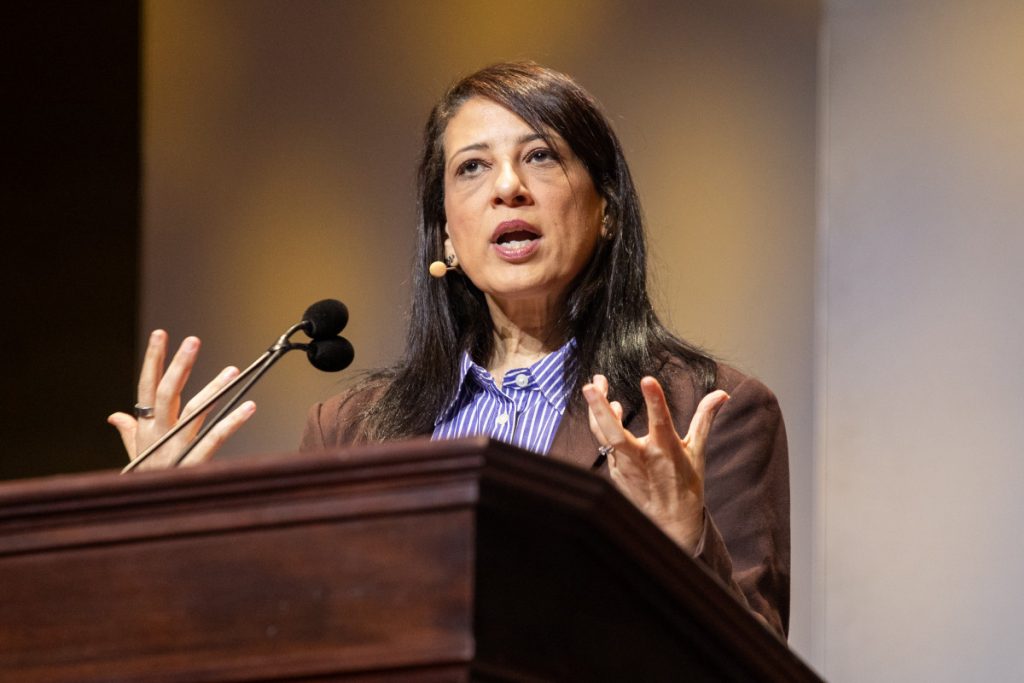
Nancy Youssef, a national security reporter and staff writer for The Atlantic, speaks on U.S. foreign policy Monday in the Amphitheater.
LAYLA VINSON
Staff Writer
Speaking from the windy stage of the Amphitheater beneath a darkening Chautauqua sky at 10:45 a.m. Monday, national security journalist Nancy Youssef delivered her assessment regarding United States foreign policy in alignment with Week Seven’s theme, “Global Power and Our Evolving International Order.” With a specific focus on covering international affairs during President Donald Trump’s administration, Youssef shared her outlook concerning the recent self-serving nature of the U.S. and the irrevocable judgements from allies and foes in response.
“I’m going to aim to do the small task of trying to explain U.S. foreign policy over the past 18 months, and try to frame some of the changes that we’ve seen over that time,” Youssef began, a crack of thunder and subsequent laughter echoing through the Amphitheater in the seconds that followed her opening remarks.
She focused her discussion on five broad changes in U.S. foreign policy — the U.S.’s global posture, its relationship with allies, the role of economics, the use of military power and its capacity to shape foreign policy. Youssef said these changes must be navigated with respect to the increasingly interwoven nature of external and domestic issues.
“We’re having this discourse at a time in which internal divisions are coinciding with foreign policy, both domestically and on the world stage,” Youssef said. She noted numerous foreign policies surrounding immigration, border security and competition with China as distinct factors that contributed to Trump’s victory.
“… We can no longer think about foreign policy issues and domestic issues aside; each one is shaping the other. Perhaps because of this, the administration’s recent views on foreign policy no longer shows how the United States should lead the world, but how engagement abroad serves America at home,” Youssef said.
Youssef highlighted decades of history in which U.S. foreign policy operated under the assumption that its leadership was a strategic asset in national interest, leading to alliances such as NATO and investments in soft power and military aid. But the Trump administration has refocused priorities toward the Western Hemisphere, reflected in its aggressive reassertion of the Monroe Doctrine with the aim of tackling a top issue for voters: border security, Youssef explained.
“But what are the risks of these changes?” Youssef asked. She said the Trump administration is prioritizing short-term extractions from the existing system as opposed to preservation of it, often without bipartisan support. “These changes were not made as part of a broad national bipartisan conversation, but rather decided by the administration. There wasn’t input from Congress. There wasn’t a discussion. So presumably, the next administration will want to change it. What parts do they want to bring back? Will they even be able to?”
Youssef further expressed her concern during the lecture regarding the Trump administration’s perspective on the U.S.’s increasing dominion over ally relations that no longer fall under “umbrella security” for reasons both financial and ideological. Current burden-sharing initiatives have led to a push for NATO members to spend 5% of their GDP on defense by 2035, as opposed to earlier 2% goals, resulting in an amassing military presence from countries such as Germany, Japan and South Korea, Youssef said.
Regarding the increasingly contingent nature of ideological alignment within U.S. alliances, Youssef looked toward Trump’s personal relationships with leaders such as Vladimir Putin and Benjamin Netanyahu as influences over U.S. foreign policy.
As prime examples of personally driven U.S. alliances, Youssef also cited the Trump administration’s decision to suspend most U.S. aid to South Africa due to its land policy and Vice President JD Vance’s open opposition of “firewalls” established by German political parties through their refusal to work alongside the far-right AfD party.
“These NATO allies contribute more to their security, which is something they’ve been waiting for for years unsuccessfully. And more capable allies could be more helpful to the U.S. in the future,” Youssef said. “… But ultimately, this hinges on the assumption that the U.S. has a big advantage and it will never need help from allies. That can undermine the very system the U.S. has benefited from.”
Youssef continued to her third area of focus, which was the role of economics, including tariffs, resources and the emerging artificial intelligence industry as primary instruments in foreign policy and coercion. Referencing increasing tariffs against countries such as Mexico and Canada and Trump’s views on natural resources necessary for data centers, Youssef said she finds the relationships between economic, political and military leverage intersect further with time.
“The administration has used tariffs in a bid to change how even close allies behave, even though those tariffs will cost the average American household $1,650 a year. Why?” Youssef asked. “Because the administration believes access to the U.S. markets is its greatest leverage, more than long-standing relations. Tariffs are now a new form of force of diplomatic power and a source of revenue.”
Shifting gears toward issues Youssef focuses on most in her day-to-day experience as a journalist, she said she evaluates the increased use of military intervention, comparing the deployment of U.S. military to at least seven countries during the Trump administration to two during the Obama administration.
“Trump has been more willing to use [military force] so long as it avoids prolonged groundwork,” Youssef said, juxtaposing past presidents who seemed more reluctant to employ military force unless a vital interest was being directly threatened. “With Trump, the military is less of a tool for managing the international order than it is one element of a broader strategy of coercive statecraft.”
Youssef also focused on the politicization and internal culture of the military, noting an increasing pressure for generals and admirals to align with Trump’s position, which led to the removal of numerous service members.
The shift toward a smaller, more loyalist circle alongside growing industrial constraints is now defining the U.S. capacity to shape foreign policy, Youssef said. On the human side, Youssef mentioned the absence of U.S. ambassadors in more than 100 countries and a group of advisors guiding Trump as a result of their direct relationship with him. On the industrial side, Youssef emphasized the opinion of a retired general who asked her to stress to audiences the national security threat posed by a lack of electricians, machinists and welders, resulting in a workforce unable to build the munitions it now needs.
“Under this administration, we have seen that capacity is just as important as capability,” Youssef said. “… Arguably, a smaller coterie of advisors allows the president to make changes faster and implement policy faster. And we have seen the administration try to address munitions shortages and treat it as a priority, but there are risks to what’s been happening in this area. The administration doesn’t appear to have factored ammunition shortages in its planning, a flaw that is a result of both the limited human and industrial capacity.”
Looking to the Iran war, Youssef said she views the conflict as a substantial manifestation and live example of each of the five issues she presented in her lecture. Ranging from weapons costs to increasing reliance on foes and the domestic expenses to U.S. citizens, Youssef said she considers the war in Iran as the “prominent foreign and domestic policy debate of our time.”
Youssef concluded her lecture by reiterating the increasingly transactional nature of U.S. deals and alliances in the name of leverage and at the cost of international order, making a final deal progressively more difficult to attain.
“For all the changes that the Trump administration has made to foreign policy and national security, the biggest change is not what they have done, but what they’ve undone,” Youssef said. “… The war in Iran has, so far at least, exposed the limits of U.S. diplomatic and military power. The U.S. keeps seeking to use its economic and its military force as leverage against that harm, but so far unsuccessfully. The outcomes will likely shape not only how the U.S. thinks about power going forward, but how allies and foes alike think about the United States.”