
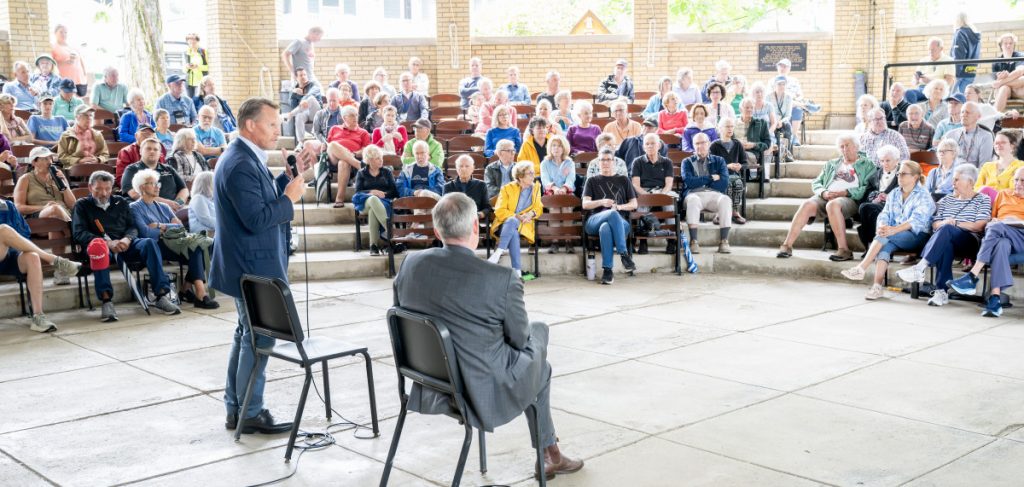
Incoming Chautauqua Institution President Mark Coolidge Johnson, joined by Interim Chief Executive Kyle Keogh, answers community questions during “Conversations with Kyle” Aug. 10 in Smith Wilkes Hall.
CODY ENGLANDER
Staff Writer

Johnson, joined by Board Chair Laurie Branch, answers community questions.
On Aug. 10, a crowd filled Smith Wilkes Hall for “Conversations with Kyle”, an open community forum discussion with Interim Chief Executive Kyle Keogh and incoming President Mark Coolidge Johnson. Keogh opened the forum by introducing Johnson to the community.
“Mark comes with a tremendous love for this place, having grown up here, been around it, seen it from all angles,” Keogh said. “What really excites me about him is if he’s half the man his father was, that’s extraordinary for Chautauqua.”
The former Deputy Chief of Mission in the U.S. Embassy in Mexico City is a third-generation Chautauquan and the son of Chautauqua Vice President of Finance Joe Johnson, who served in the role for 20 years. Before taking questions from Chautauquans, the incoming president addressed the community about his new role.
“For me to be able to come home and be part of all of this has been, just, I use the word blessing, but it’s a privilege, and I thank Laurie [Branch] and the whole team for giving me this opportunity,” Johnson said.
The first topic of conversation during the forum was Chautauqua’s declining Canadian population.
“ … We estimate that about 4% of folks who come to Chautauqua each year are Canadian,” Keogh said. “ …The folks who I’ve talked to, and there are some — like the people who own nearby my house — [who] are basically like, ‘Right now with everything that’s going on, I will not cross the border. It doesn’t matter what you put on in Chautauqua, I will not cross it.’”
This opened up a broader conversation about the Institution’s audience demographics and why Chautauqua’s demographics may skew away from young adults.
“16 to 20 [year-olds], we get a little bit wonky. Honestly, what we worry about is alcohol consumption for that group, and we’ve had some incidents this summer that are pretty concerning for us,” Keogh said. “What we’ve done is try to go through the 18-21 to 35 [year-old] crowd. It’s the [demographic] that we lose the most. Basically, you get into college, you finish your sophomore year, you’re worried more about getting a job, so you get an internship, and we can tend to lose you until you have children.”
The next question, directed to Johnson, was about the future success of Chautauqua and what that looks like when addressing future priorities.
“ … Chautauqua [doesn’t] need a major overhaul. It needs some tweaks, and I think Kyle and the team have done a fantastic job of doing that, trying to improve the finances, trying to make the experience better each and every year,” Johnson said. “I’m a sports guy, and I look at things like blocking and tackling. If you get the blocking and tackling right, then you can start looking at how you can build out your team. Right now, blocking and tackling has come a very long way in the last year or two, and I’d like to be part of making that even better.”
The open dialogue then transitioned to accessibility on the grounds, especially for Chautauquans using scooters, noting issues with mobility and elevators in the Institution.
“Each time we have to update a building, we make that a priority,” Keogh said. “But we have 140 buildings, and we have not been able to get to all of them, which has been some of the challenges.”
Keogh noted that the issue, at its core, is “budget restraints”; with the current capital expenses budget, the Institution lacks resources to ensure every space can be accessible.
The topic of accessibility then turned to audio issues within the Amphitheater. Prior to the 2026 Season, the Institution installed a new sound system. The Institution considered adding closed captions, but ultimately decided to prioritize a new sound system.
“We looked at captions,” Keogh said. “Actually, if you go to captions.chq.org, you can get them on your phone. The cost of actually putting the equipment to actually allow them to be played in the Amphitheater is fairly significant. So, we prioritized investing in the audio, the overall audio system, to try and significantly improve that, more so than we did the visual effects.”
Keogh added that the Chautauqua Bookstore sells accessibility devices to enhance patrons’ experiences.
“We have a full range of disabilities and abilities here at Chautauqua — in particular, audio — and we’re never, probably, going to get to the point where we can really adequately cover those,” Keogh said. “There are going to be existing, upgraded systems like the one at the [Chautauqua] Bookstore that can help address it for you.”
One Chautauquan raised the topic of content of the 10:45 a.m. morning lectures, opening a discussion about traditional lectures versus lecturers in conversation. Keogh said more widely-known speakers often have tremendously busy schedules, which can make it difficult to write and prepare an entire lecture, while lesser-known speakers are more willing to write a speech.
“[Bigger speakers] feel much more comfortable conversationally, so we have to make some trade-offs on those and some of the back-and-forth,” Keogh said.
A Chautauquan asked Johnson about experiences he has previously enjoyed at Chautauqua. He said in his youth, he often enjoyed water skiing on Chautauqua Lake and attending morning lectures before lunch.
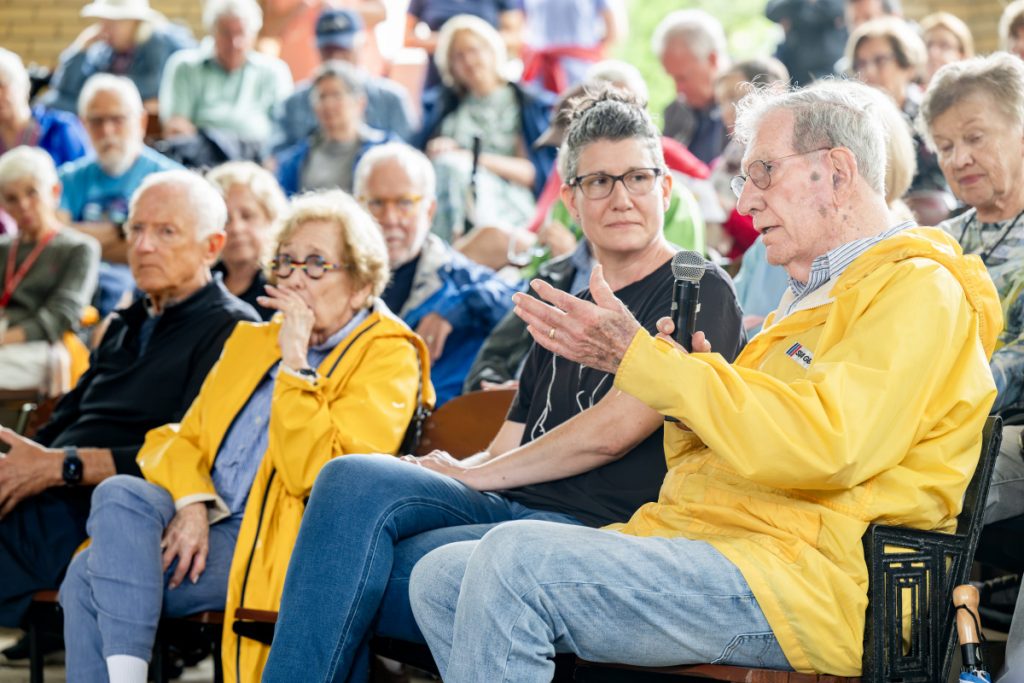
Jerry Chichester, right, asks a question about accessibility and Amphitheater audio quality as his daughter Susan Chichester looks on.
“We’d wake up — not as early as we’d like — but early enough to try to hit the glassy part of the lake and go water skiing. And then, I would try to get back to the 10:45 [lecture], depending on what the theme was. Having both of those pieces of the puzzle just before lunchtime was just incredible. Then we (would) go up and we (would) try to get my dad to move some money to see if he could buy us some lunch,” Johnson reminisced.
He credited his time at the Institution as being the reason he went on to work for the U.S. Department of State.
“ … Chautauqua was the reason I joined the State Department, and having that access to, in that case, … U.S. ambassadors and people with the State Department, some Soviet leaders as well, was something that you just can’t put it all together and get it in one place, in one package.”
Johnson said he values communication and shared dialogue; he said he plans to listen to the community’s ideas and figure out how to best implement the best possible Chautauqua.
“We’re not going to be able to do every idea that everyone has. I can’t even do every idea that I have,” Johnson said. “In fact, many of my ideas are not good ones. I need to kind of throw them out there, hear what people react to it, bat it around a little bit, and say, ‘Maybe that’s the kernel of a good idea.’”
“Conversations with Kyle” will continue with Keogh at 1 p.m. today in Smith Wilkes Hall, with a focus on recently proposed housing development additions within the Institution gates. Johnson will not be in attendance.