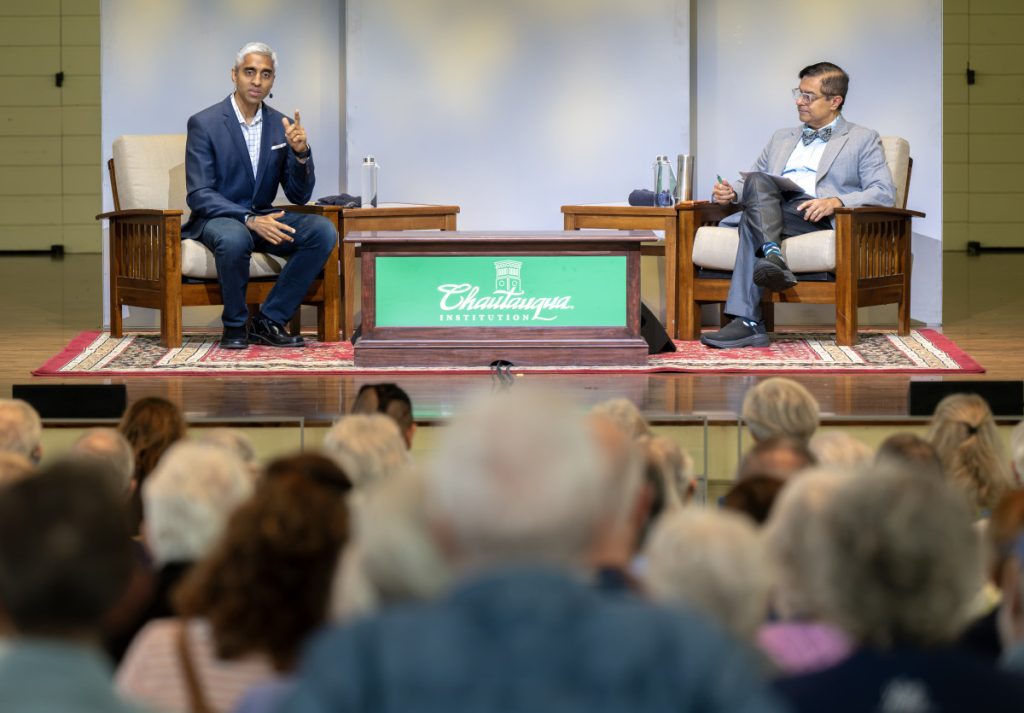
Former Surgeon General of the United States Vivek Murthy speaks about loneliness as a public health issue in conversation with Interim Chief Advancement Officer and Senior Director for Community and Belonging Amit Taneja Thursday in the Amphitheater.
ROCCO PRIOLETTI
Staff Writer
For physician, author and former Surgeon General of the United States Vivek Murthy, Chautauqua Institution’s community-focused environment is something “America needs more of.” Arriving on the “magical” grounds for the first time the afternoon before his lecture, Murthy witnessed Chautauquans bond through both leisurely recreation and open, informative conversations.
“I just want to commend you on what you have built. I knew you were part of the legacy that stretches back more than 150 years, but it’s a legacy worth protecting, worth investing and worth supporting,” Murthy said.
Despite social connection becoming an integral component to Murthy’s advocacy and work at large, he said his past self would have viewed the importance of the topic with a sense of skepticism. Loneliness was not taught in medical school or during residency training, yet the feeling remains ever-present.
“From the first moment I set foot in a hospital, I realized how many of the patients that I was caring for were struggling with loneliness,” Murthy said.
Murthy recalled being on surgery rotation during his third year of medical school, where he met a woman lying on a bed. She was shaking. Unable to speak from a previous surgery related to voice box cancer, she wrote to Murthy that she was scared she was going to die. Murthy tried to recall his training to provide relief and the best-suited response for the patient. Instead, Murthy held out his hand and together they held onto each other, in silence, for 10 minutes.
“During those 10 minutes, I saw the tears streaming down her face start to slow. I saw her breathing start to slow down as well, as did mine. And in the end, when it finally came down to say goodbye, I hadn’t cured her cancer. I hadn’t changed her odds, per se, of her surgery being successful. But, we both left feeling a little bit more grounded and a little less alone.”
When Murthy became surgeon general, a communications team from the Department of Community wanted him to launch an established communications plan supported by various media circuit appearances. However, Murthy came in the next day with a new plan that comprised his listening tours, during which he heard accounts of loneliness nationwide from both young and old, ranging from college students to parents.
“The reality is that what I was seeing, and what we collectively have been uncovering, is an extraordinary and underrecognized public health challenge that not just America, but the world has been facing,” Murthy said. “… There are consequences of loneliness for our physical health in terms of increasing risk for heart disease, for dementia, reducing our overall lifespan and increasing mortality. There are risks to our physical health that are comparable to smoking.”
Murthy noted that compassion is at odds with the systemic incentives within academic medicine. This emotional component is important for professionals, but it is not rewarded; academics are promoted for bringing in “millions in grant-funding,” not being a “deeply empathetic caregiver,” despite both having great value.
“Just out of curiosity, by the show of hands: How many people believe empathy and curiosity are important in their doctors?” Murthy asked, to which the audience laughed. “For the record, let it show that every hand went up.”
Medical training is an invaluable time to instill the importance of empathy in others through role models that “lead with the head and heart.” For Murthy, Dr. Rachel Naomi Remen — an important mentor who died two weeks ago — was “an embodiment of that empathy and compassion.”
“She reminded us that it is in our stories, in part, that we realize everyone has mystery and beauty and value to bring to the world — if we are willing and able to stop and listen to their stories. Sometimes, that’s the hardest part,” Murthy said.
He recalled a story from Remen about a patient who was unwilling to recount her personal stories. Just before Remen was about to leave the room, the patient informed her that she had been on the Titanic when it sank. This patience and willingness to listen reminded Murthy of his first month of medical school, when his professor advised him during practice interviews.
“‘If you listen to the patients, they’ll tell you what they need,’” Murthy recalled. “It was a simple but powerful source of wisdom that I realized goes far beyond medicine. I realize it’s what we need to do better with my kids. It’s what I need to do better with my wife and my parents.”
For Murthy, directly hearing from people is of the utmost importance. The cynicism or inattention that arises from an overreliance on numbers, data or milestones is a reminder to reconnect on a personal level. In doing so, Murthy felt optimistic about the country through personal connection and contributions to the community.
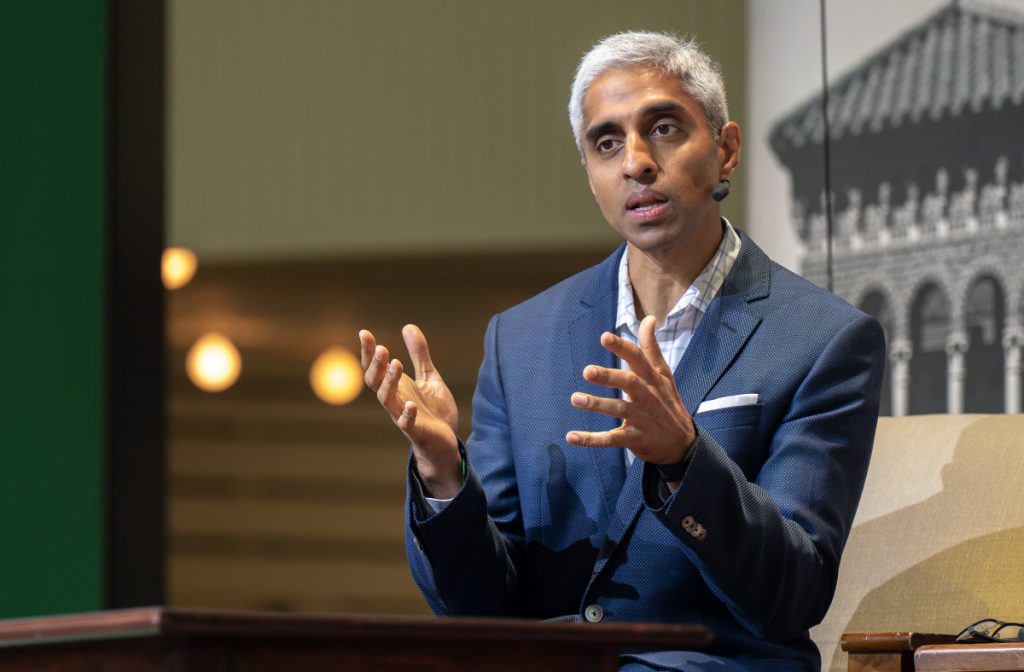
Former Surgeon General of the United States Vivek Murthy speaks about loneliness as a public health issue in conversation with Interim Chief Advancement Officer and Senior Director for Community and Belonging Amit Taneja Thursday in the Amphitheater.
There are both benefits and drawbacks to the interconnectedness of technology, in Murthy’s perspective. While social media platforms allow users to keep in immediate contact with those across the globe, they simultaneously incentivize the quantity of relationships rather than the quality of them.
“What we have to do is reclaim our connections with one another by coming back to how it is when people fundamentally connect in the first place,” Murthy said.
From an evolutionary standpoint, indirect communication online disrupts the physical components — body language, vocal inflections, facial expressions — that help contextualize the impact of interpersonal communication. Without it, hateful speech is spread more easily online, Murthy explained.
Murthy realized the necessity of supporting family, friends and “day-to-day community” in November. He described a 3-week period when his wife and mother were diagnosed with cancer and his grandmother died. Afterward, his friends helped out significantly — driving down to visit with support, or arranging a WhatsApp group with Murthy’s friends.
Murthy said that these acts of kindness were not luxurious or broadcast for all to see on social media. Instead, they were “small but extraordinarily powerful acts of love we have the power to offer one another. That is how we build connection.”
Murthy’s mission to recenter the importance of connection and community is reinforced by details patients shared in their final living days. They reminisced on loved ones and personal relationships, not financial aspirations.
“If we succeed, then we will build a foundation for society that could withstand profound challenges, because we are taking them on together,” Murthy said. “But, if we fail to mend the social fabric, if we continue to dissent into deeper levels of isolation and loneliness, then — regardless of how much AI is doing our job and cleaning our dishes and taking care of our garden, regardless of how much money we may have in the bank — we will leave our lives having checked all the boxes of achievement, but feeling unfulfilled.”
With artificial intelligence technologies substituting human relationships, Murthy called to protect the core elements that define what it is to be human.
When dealing with loss, Murthy emphasized the importance of showing kindness toward others. Even a small gesture can leave a lasting impact on somebody. He felt this firsthand when his wife was diagnosed with breast cancer.
“One of the easiest things to do in our world is to forget the power we have to help other people heal. And in healing others, it turns out we ourselves are healed too,” Murthy said.
Murthy recalled when he had a frozen shoulder a few years ago, and how he felt his son’s hand comfort him after he jolted it too quickly. He said that values like compassion are strengthened “when we are grounded in love and committed to each other.”
“It’s often been said America, at our best, can be a beacon to the world. This is how I want this to be a beacon. Not only with our economic accomplishments and renovation, but with our moral leadership to show that there is a different way to live, a better way to live that can be anchored in the core values of being human: in our love, compassion, generosity. And that is a source of strength and one we can embrace,” Murthy said.