Tag Archives: judy barie
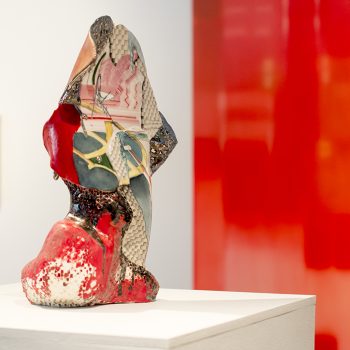
Vanessa German’s power figures are constructed from found objects. “They come with a history, and they come with an identity,” she said, “and they come with so many stories inside … already.” German’s work is on display for the remainder of the season, in the Strohl Art Center Bellowe Family Gallery exhibition “American JuJu.” Photos by Lauren Rock.

In ‘American JuJu,’ Strohl displays power figures that reckon with liberty, value, humanity

Vanessa German’s sculptures have the power to fly, to sing, to heal ailments, to call deeply upon history, to spark curiosity and to bind us together in our humanity. Her mixed-media found-object compositions have their roots in her endlessly creative life as a poet, photographer, actress, designer, educator and sculptor.

Her solo exhibit, “American JuJu: Root and Power for a New Century,” opens today from 3–5 p.m. in the Strohl Art Center’s Bellowe Family Gallery, with German performing several of her spellbinding spoken-word poems at the reception.

“I grew up in an environment where there were always the ingredients for making something else,” said German, the daughter of a fiber artist who encouraged her children to create, to read and to perform. “There was never a time in my life that I don’t remember making things and being a performer. That’s how I knew myself; that’s how I understood who I was.”

Read more
Wesley Anderegg. “Man,” “Two Headed Man,” “Woman,” “Lollipop,” “Man with Pipe.” Ceramic plates. 18˝ × 23˝ 
Photo by Lauren Rock.

31 nameless orphans, looking for a home

Very few pictures wear name tags. Naming is the province of the caption, or of an oral tradition, sometimes passed on from parents to children, but more often eluding the good intentions of commitment to writing. The boxes of anonymous photographs in most home closets are silent testimony to this nominative failure. Worse yet, consider the images of family and friends banished, orphaned, at estate sales and flea markets, touching evidence of the painfully anonymous tradition of the portrait.

Judy Barie, director of the galleries of the Visual Arts at Chautauqua Institution, has opened an image shelter for the nameless at Strohl Art Center, in which she offers 31 unnamed images to patrons ready to provide foster parenting and a new home for only partially identified images.

Yes, there are a few pictures known by first names in the shelter — Allen, Joe, Steve, Trudy, Joe, and Virginia among them. Otherwise, we must be content with Two Headed Man, Small Female Head, Young Bride, and Teens on the Beach.

Read more
Michael Ferris Jr. “Allen” and “Steve.” Reused wood, pigmented grout.
Photo by Lauren Rock.

‘Anonymous’ exhibition provides new insights on subject, viewer of portraits

Portraits are everywhere: George Washington’s profile on the quarter, Greek and Roman statues, the Mona Lisa, wedding photographs, death masks on sarcophagi.

Portraits immortalize. But though they seem to be common, a different side to them emerges in Strohl Art Center this week in “Anonymous: The Contemporary Portrait.”

From 3–5 p.m. today in Strohl is the opening reception for “Anonymous,” a collection of everything that is a portrait without being, in fact, a portrait. Curator and VACI Galleries Director Judy Barie was inspired by Christian Faur, who creates art with thousands of hand-cast crayons, which resolves into images only at a distance.

Read more
Several “D.P.W. Platters,” by Boris Bally, are on display as part of the “Recycle. Reuse. Reinvent.” exhibition at Fowler-Kellogg Art Center. Photo by Michelle Kanaar.

Fowler-Kellogg exhibits deep, thoughtful work

Scrap metal, cereal boxes, tea bags, plastic container lids: “Recycle. Reuse. Reinvent.” It is an exhibition of art sponsored by the Visual Arts at Chautauqua Institution.

But are there no limits, no boundaries, for the artist? Scrap metal?

“Recycle. Reuse. Reinvent.” is Judy Barie’s nominative for a harvest of invention, for an art that looks out and beyond rather than drilling analytically into some reduction. Barie is VACI curator and director of the galleries on Wythe.

One might figure Barie’s parallel exhibition in the Fowler-Kellogg Art Center as a counterweight notion to the ebullience of the ecology of “Recycle.” The parallel show is called “Transitions in Black and White,” meaning how one essentially black and white work in one medium transitions into a black and white work in another medium.

But guess again. Those artists are more interested in addition than subtraction.

Read more
From the exhibition “Recycle. Reuse. Reinvent.” In the foreground, “S/He” by Amy Lipshie; in the background, two “Memento Mori: Mottoes” by Mary Mazziolli and two “D.P.W. Platters” by Boris Bally. Photo by Michelle Kanaar.

Fowler-Kellogg embraces multimedia challenge

This season, the Fowler-Kellogg Art Center has created a different world on each of its floors.

Downstairs is a subtle, stylish, black-and-white affair that explores the depth of the two most basic colors. Upstairs is a multimedia romp through a playground of colorful re-imaginations of everyday objects.

Sunday at 3 p.m. is the opening reception of the two shows, “Transitions in Black and White” and “Recycle. Reuse. Reinvent.”

Judy Barie, director of galleries for the Visual Arts at Chautauqua Institution, curated both shows.

“I really enjoy doing two completely different shows,” she said.

Read more