
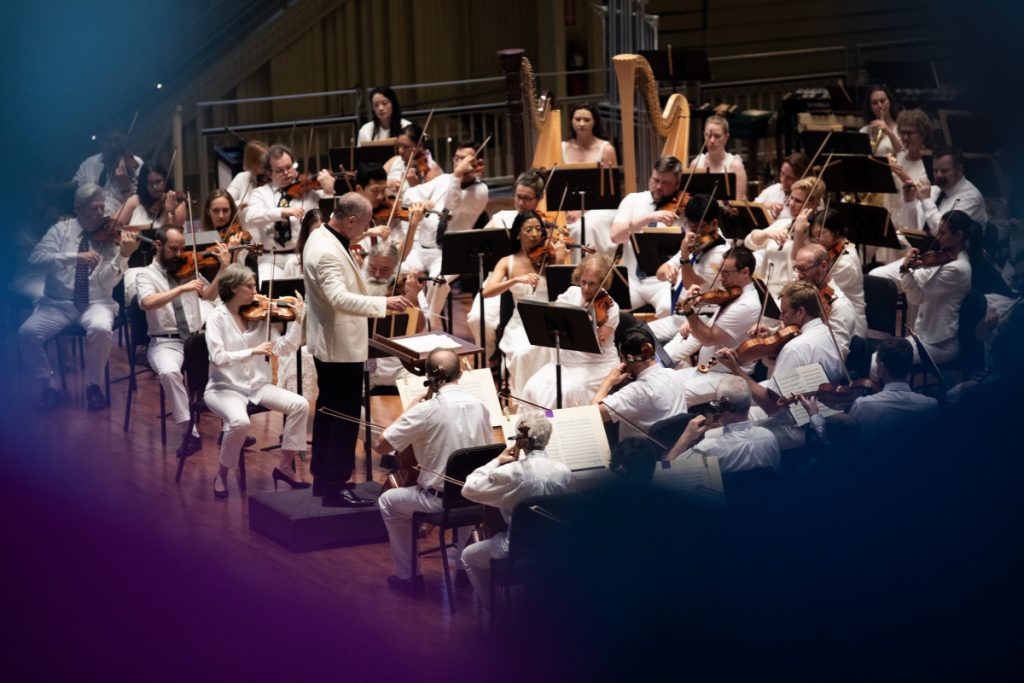
Conductor Rossen Milanov leads the Chautauqua Symphony Orchestra as they perform Holst’s ‘The Planets’ Saturday in the Amphitheater.
ROCCO PRIOLETTI
Staff Writer
For Timothy Muffitt, artistic director of the School of Music, Ludwig van Beethoven’s Symphony No. 3, “Eroica,” is a “watershed work,” acting not only as a turning point for the composer, but for music at large.
“… You can’t follow [up] the ‘Eroica’ Symphony with anything. It’s such a powerful and massive statement,” he said about tonight’s monumental closing masterpiece, performed by the Chautauqua Symphony Orchestra.
“He ushered us over the hump of the 18th into the 19th century, incorporating so many ideas from the Age of Enlightenment,” Muffitt said. “But, ultimately, embracing the age of the individual — which is how we live now.”
Beethoven’s adoption of the interior human experience as being a valid source for artistic expression made the composer exceptionally groundbreaking and “radical” in 1803.
“So, in contrast to Mozart and Haydn and Bach and the people before Beethoven — who were just trying to often create something of extraordinary beauty — Beethoven was one of the first composers to really embrace the idea of personal expression in music, (as if Beethoven was saying) that this is something about what I’m feeling, right now, as a composer,” Muffitt said.
The colossal stature of Beethoven’s “Eroica” Symphony is felt throughout every aspect of the work. For perspective, the program’s opening piece, Christopher Theofanidis’ “Rainbow Body,” is shorter in its entirety compared to Beethoven’s first movement.
“The first movement, alone, is as long as some of the symphonies that Haydn and Mozart wrote,” Muffitt said. “He created something of a completely different weight and level of gravitas in this symphony.”
Under Muffitt’s baton, the CSO will open their program with Theofanidis’ “Rainbow Body” and conclude with Beethoven’s Symphony No. 3, “Eroica,” at 8 p.m. tonight in the Amphitheater.
Despite being composed in 2000, the foundation of “Rainbow Body” sprung from old traditions, such as the ancient music of Hildegard of Bingen — a female composer during the High Middle Ages.
“After an introduction, [the] music reaches out to us with these echoes of an earlier time, that, I think, immediately kind of bring[s] the listener into the picture and set[s] a certain tone,” Muffitt said.
Theofanidis’ influences encompass not only the outreaches of musical tradition, but spirituality as well. The title, “Rainbow Body,” refers to the Tibetan Buddhist belief of the “recycling of positive energy” after death through energy’s absorption and return into the universe.
“Those are two powerful ingredients to mix into a work of music,” Muffitt said. “Theofanidis has a great skill at bringing these ideas to life and mixing them together and creating a beautiful arc of an experience over the course of the approximately 12 minutes of the work.”
Contextualized beside each other, the two pieces ebb and flow through contrasting periods and perspectives. Theofanidis harkens back to ancient song and unity through spirituality, while Beethoven looks inwards towards the self, introducing modern artistic expression via individuality.
“It ends up creating kind of an arc form, doesn’t it?” Muffitt said. “We go back centuries, centuries and centuries and fold it over into this time of Beethoven who brings us a little bit more up to date — even though the first work is the more recent of the two.”
Muffitt shared his excitement for the performance.
“It’s always a pleasure for me to make music with my friends and colleagues in the CSO.
I enjoy listening to them all summer long,” Muffitt said. “And so, I always look forward to this opportunity to share the stage with them.”