
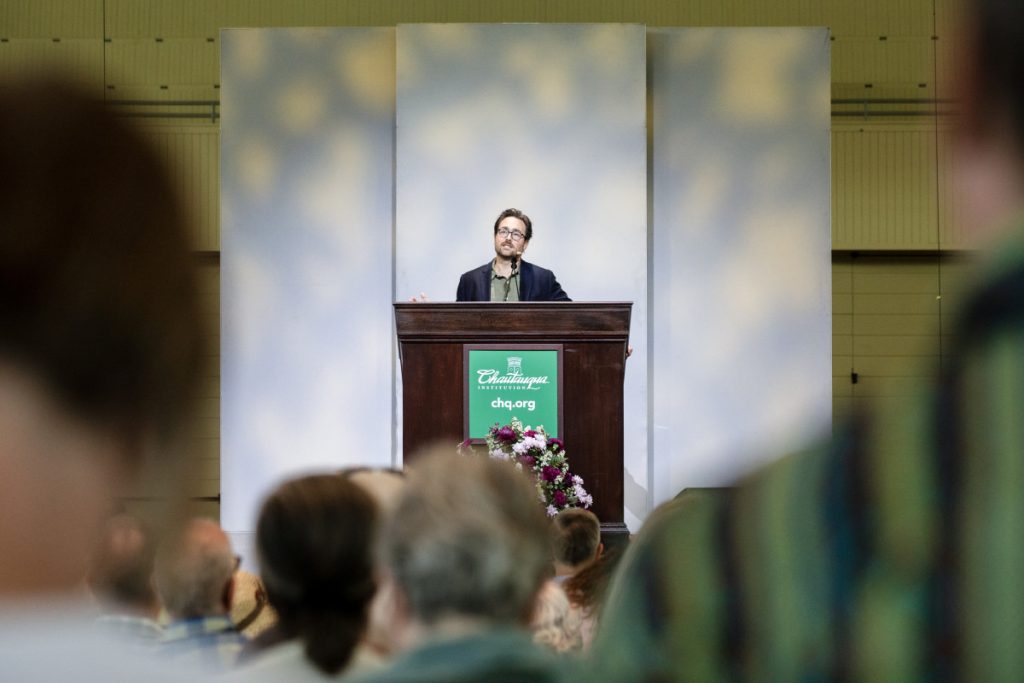
Columnist and staff writer for The New York Times David Wallace-Wells speaks about the state of climate change and waste Monday in the Amphitheater.
ARIANNA NEVAREZ
Staff Writer
At 10:45 a.m. Monday in the Amphitheater, David Wallace-Wells opened Week Four’s Chautauqua Lecture Series theme, “Wasted: Our Era of Disposability,” with a lecture on the topic of climate change and pollution.
Wallace-Wells is a columnist and staff writer for The New York Times, where he writes a weekly newsletter on climate change, technology and the future of the planet. He is also the author of the NYT bestselling book The Uninhabitable Earth, which investigates the consequences of global warming.
Wallace-Wells began his lecture by defining “cathedral thinking,” a term that he said is “meant to both lament some shortcomings about modern life and to point us in a better direction.” He contextualized this by explaining that relatively recently, humans gathered to design projects that took generations to make and were meant to last for centuries.
Now, he said, there is a shift in this thinking. Instead, people are looking for things that are made quickly and inexpensively, yet society doesn’t give much thought to how long these projects will endure.
“We can think of the world in those terms: disposability, waste, ephemerality,” Wallace-Wells said. “… But the thing is, nothing really ever gets discarded — only passed along, deposited somewhere. … But what we call ‘disposable’ is often just a different kind of permanent, a different place of permanence; out of sight, out of mind perhaps for now, but not for long and not for everybody.”
When people think about climate change, Wallace-Wells said most consider global warming as a “problem of centuries” and “caused by our great-great-great-grandparents,” but half of all carbon in the atmosphere can be attributed to the burning of fossil fuels that has occurred in the last 25 years.
Other aspects of climate change, he pointed out, are the speed of global warming and “horrifying disasters.” Wallace-Wells said events like “500-year storms,” which are defined by extreme rarity, are now occurring more frequently and thus losing their meaning.
Though carbon dioxide, the main driver of climate change, is often described as an invisible gas, it is a measurable substance, according to Wallace-Wells. He said the carbon humans have put into the atmosphere weighs more than “everything we have ever built on the surface of this planet” and “more than the total mass of all life on Earth” combined.
“This blanket of carbon, which is the most significant thing, the most visible thing and the most lasting thing we have ever beamed out into the universe, it’s beautiful in its way. Anything so large and lasting has to be,” Wallace-Wells said.
On the topic of fossil fuels and their effects, Wallace-Wells said at least five million people die prematurely annually due to the burning of fossil fuels. He said on days with high levels of smog or air pollutants, living in Delhi, India, is equivalent to “smoking several packs of cigarettes,” and the city has the highest rates of respiratory illness in the world. Air pollution has been linked to mental illness of all kinds, worsened memory, as well as attention-deficit/hyperactivity disorder and autism spectrum disorders, according to Wallace-Wells.
Wallace-Wells continued discussing the detriments that accompany even small increases in air pollutants.
“Those breathing dirtier air in childhood exhibit significantly higher rates of self-harm and adulthood … Depression in teenagers quadruples. Suicide becomes more common, too.
Stock market returns are lower on days with higher air pollution. Surgical outcomes are worse. Crime goes up. … A 10% reduction in pollution could reduce the cost of crime by $1.4 billion a year,” Wallace-Wells said. “In 2019, a comprehensive global review found that air pollution damages every organ and virtually every cell in the body.”
Plastic pollution was another aspect of waste Wallace-Wells addressed; he said an explorer in 2019 found that plastic has been deposited in the ocean more than natural light has ever reached.
Wallace-Wells also said plastic has been found in ovarian follicular fluid and testicular tissue, “already embedded in not just the yet-to-be-born, but the yet-to-be-conceived.” He said scientists call this the “exposome,” which is “the sum of external exposures encountered by each of us over a lifetime, which portion and shape our fate alongside human behavior.”
Wallace-Wells acknowledges the “bleakness” of all of the information.
“Even while we tell ourselves seemingly every day we are masters of our own destinies, I wonder why we look back at that evolutionary history and refuse to see clearly that we today are also the product of the conditions which we make, which we are therefore in control of, which we are the authors of — if we dare to acknowledge responsibility,” he said.
To close, he made three final points: There is almost no such thing as real disposability or recyclability; this generation will live through and with the waste; and “the effects, all things considered, are relatively limited.” He also said humanity is “past the peak of global air pollution.”
“We are — most of us — living flourishing, rewarding lives, even in the face of environmental contagion and climate crisis,” Wallace-Wells said. “Almost certainly, that will always be the case, and that means this is not a fight to avoid extinction, and it is not a fight to avoid cinematic disaster enwrapping the whole globe. It is a fight to make life in the future better than it is right now. We can’t let the size of the challenge push us into fatalism. Perhaps we can be comforted that the size of the challenge today seems on the margins.”
He said that in this situation, humans must look past their own fate at an individual level and think about others around them.
“It’s a perverse and profound lesson that the problem of pollution teaches us. Whatever we tell ourselves, however our culture instructs us otherwise, we are not autonomous from one another or from the world around us,” he said. “The person is an inviolable unit, but we are in fact connected to each other and to everything that all of us does every day. Everything we burn, we breathe. Everything we discard, we discover. And everyone is in it all together.”