JENELL TAYLOR
Staff Writer
Last year, mixed-media ceramist Lydia Thompson traveled to Ghana to research its traditional architectural structures and how the clay used to create them reflects the country’s efforts to protect its cultural heritage. These investigations are what set the groundwork for her newest sculpture series that explores cultural narratives through the lenses of landscape, migration and ancestral memory.
“When I was in Ghana, I stopped by a village that had an adobe house that was half caved-in,” she said. “There was this mentality of ‘We’re not going to tear this down,’ since it was their grandfather’s house. So they raised money to rebuild that half of the house.”
Thompson said clay can be thought of as a living organism that transforms based on how and where it is built. When an adobe structure needs repairing, fresh clay is layered atop it, strengthening the foundation with the same material it was erected with.
“You’re really interacting with the form and the wall itself. Instead of taking a two-by-four and nailing it together, you actually massage it,” she said. “When you start adding more adobe to the surface, you’re building the skin again, which is really different from the way Western architecture is constructed.”

Thompson’s work is also inspired by her grandparents’ experience fleeing racial turmoil during the Great Migration, as well as by the unashamed vulnerability displayed by celebrated Black female authors such as Toni Morrison and Alice Walker.
“We tell people that you gotta have thick skin — and yeah, you do — but sometimes, you feel vulnerable,” she said. “And that’s okay. That’s just being human.”
Thompson’s works are displayed in the exhibition “Cutwork,” alongside pieces by Elizabeth Alexander, Teresa Faris, Piper Shepard, R Justin Stewart and Michael Velliquette. The exhibition gets its name from a needlework technique that takes a simple base fabric and cuts it into delicate, lace-like patterns.
“Here, we may consider what is removed, what is inherited and what is built,” curator and Associate Director of Chautauqua Visual Arts Galleries Erika Diamond said. “Cutwork” will have its opening reception from 3 to 5 p.m. Sunday in the Main Galleries of Strohl Art Center and will remain on view through Aug. 25.
Interdisciplinary artist Alexander’s work is also built upon the foundation of her familial history. Having grown up in the loving yet tumultuous environment of her working-class family, her works uncover the complexities enmeshed within ideas of gender, status and home life.
“Raised to see the possibility in found or unwanted things, I regard the domestic environment as an extension of human ingenuity: every curtain sewn by mom, steel furniture made by dad, a dollhouse made of old bookshelves,” she said. “Nearly everything in our house was handmade, upcycled, scavenged or handed down.”
In undergrad, Alexander pursued ceramics, glasswork and metalwork — techniques she has since adapted to fit her practice in order to manipulate found material artifacts that are reminiscent of those from her past.
“The shape and scale of my current work ranges from small sculptural objects such as a disassembled teacup, to photographic prints of altered environments, to site-specific installations with sound and performance,” she said.
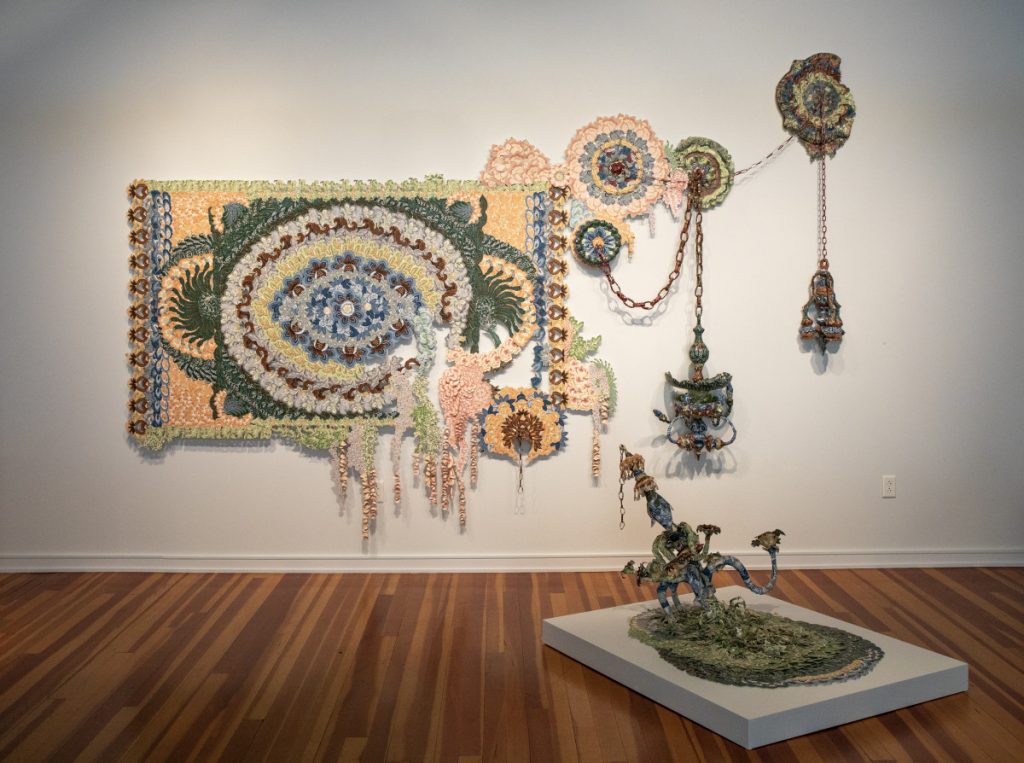
Alexander’s primary piece in “Cutwork” is an installation made entirely of paper titled “Let Him Speak First.” It consists of various cast paper objects covered in a collage of hand-cut wallpaper flowers. Inspired by an early 20th-century advice book for new wives, Alexander said she wanted the image of sentimental, domestic niceties to contrast with the title’s darker implications.
“The text points to an unspoken hierarchy and implies a covering-up. It is not uncommon to enter a space that is lovely on the surface, but has an essence of something unpleasant that you can’t quite put your finger on,” she said.
As a student, Alexander said she was often criticized for making work that was too decorative and pretty. Despite her efforts to stifle it, this delicate quality persisted in her art. She went on to learn that during the Pattern and Decoration movement of the 1970s, ‘decorative’ was a deliberate insult hurled at works made by marginalized female artists in an effort to uphold male-dominated art movements as more sophisticated in practice.
“In truth, there is a lot of power in presenting difficult topics of social hierarchy, mental illness, class struggle, etc. packaged in prettiness, in something decorative,” she said. “Additionally, I like the entry point that household objects can provide to a work of art.”
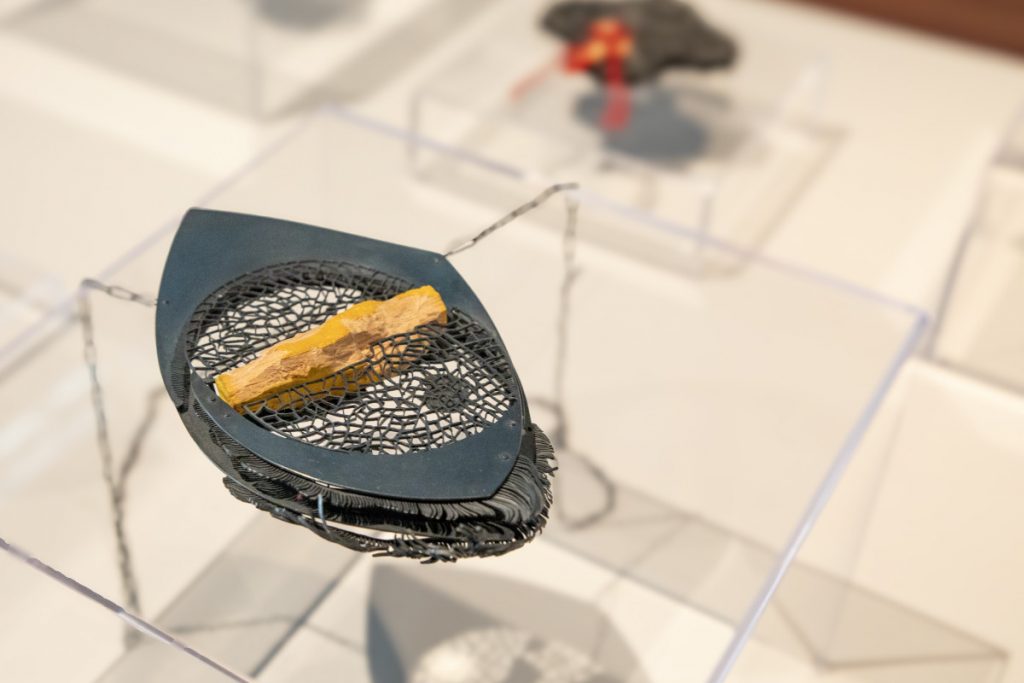
Multimedia sculptor Faris is also concerned with making sense of the notions around human advantage and disadvantage. She, however, uses metal and wood to examine these themes. Since 2006, she has been living with sarcoidosis, a rare inflammatory disease that primarily affects the lungs and lymph nodes.
“When I was first sick, I was told I had four months to live, so the work I made was quick and able to be completed in minutes or hours. During the first three and a half years, I was on high dose prednisone and made hundreds of works,” she said.
Faris’ sculptural jewelry was created from the aftereffects of self-pacification and addresses anxieties surrounding assimilation, rejection and isolation. The pieces combine intricately cut metal with wood altered by her pet, a rescued umbrella cockatoo named Charmin.
Following her illness, doctors identified Charmin’s dusty hatchling feathers as a possible irritant to her health. To test the theory — as sarcoidosis has no definite cure with no traceable origins — Charmin was kept caged while Faris was evaluated.
“I realized very quickly that Charmin’s obsessive chewing of wood in an attempt to ease the anxiety was no different than what I was doing in my studio by repeatedly cutting metal,” she said. “The process of cutting allows my brain to just respond intuitively — I don’t have to have a preconceived plan.”
The meditative qualities in Faris’ practice help to keep her grounded in her body while providing brief moments of respite from the uncertainty that she continues to face.
“I look forward to the next shift,” she said. “I don’t know that I will ever be able to approach anything without the weight of illness pressing down, but I’d love to see what that could look like.”
Using textile as a mouthpiece, fiber artist Shepard weaves botanical imagery and openwork patterning into large, hand-cut pieces that encourage dialogues around endurance, fragility and resilience.
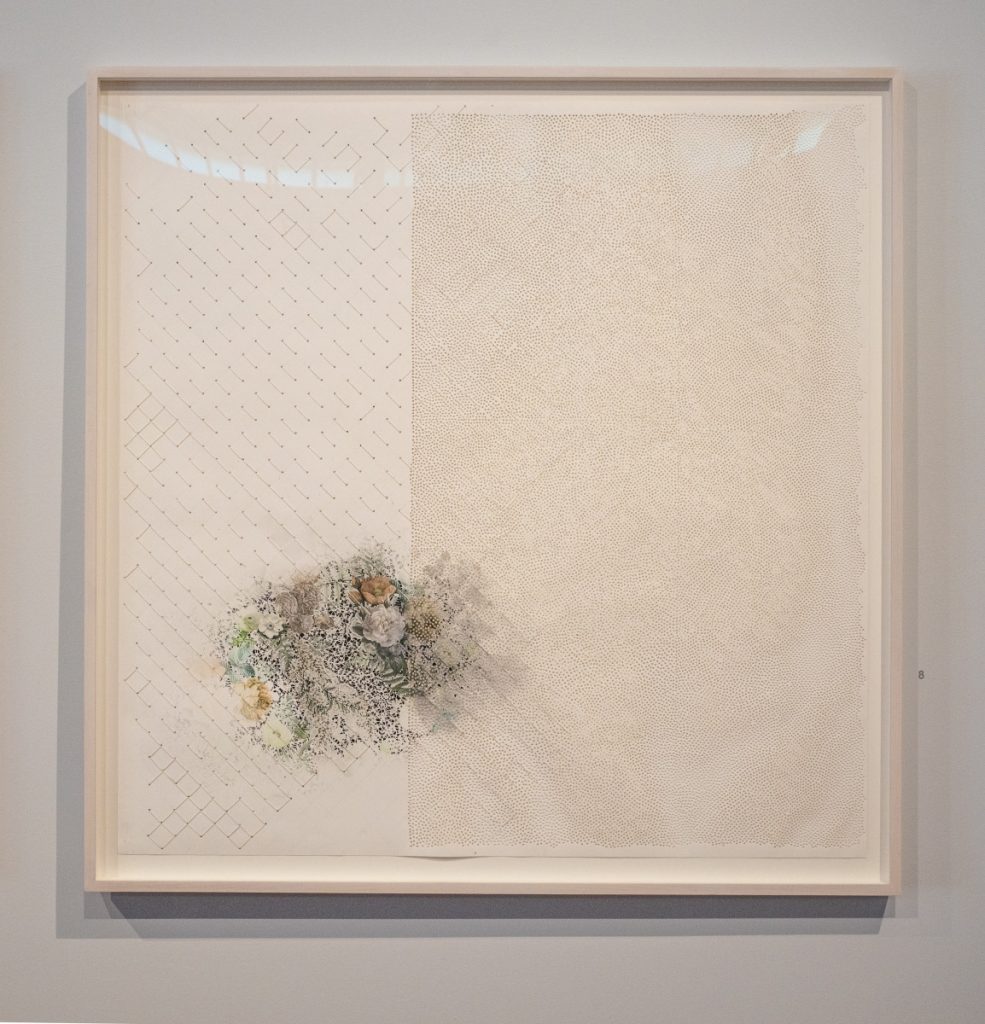
“The qualities of lace and lace-like textiles — their delicate, transparent, voided and complex construction — are what I am drawn to,” she said. “I think about my cutwork as drawing in space and one that reveals the mark of the human hand.”
Shepard refers to these qualities as “the ethereal textile.” She described the emotional resonance that comes to the surface when fiber is manipulated and the complicated beauty that accompanies her practice.
“There’s a tenuous nature and fragility of constructing or deconstructing something with a process that just teeters on the brink of dissolution,” she said. It brings a tension that can take a piece toward its most fragile limits.”
One of her pieces in “Cutwork,” titled “Only Their Silhouettes,” reveals ideas of remembrance and loss through its construction.
“I believe our familiarity with cloth moves beyond the functional and carries an emotional necessity in our lives,” she said. “I use the language and connection of textile in my work; what it feels like, sounds like, looks like, how it is constructed and how it can conjure memory.” She calls this familiarity a “sensorial wisdom.”
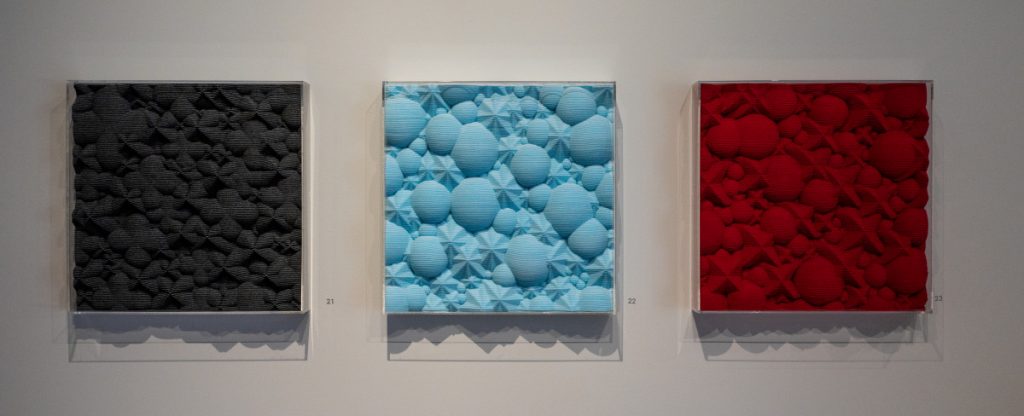
Traversing the tension between softness and structure, the wall sculptures made by multimedia artist Stewart toy with viewers’ perception through their unusual means of construction.
“All of the pieces [in the exhibition] are made from a process where I draw them in Adobe Illustrator — there’s no three-dimensional modeling, it’s all flat,” he explained. “The first time I actually get to see the piece is when it’s cut and stacked.”
Stewart’s process begins with a digitally designed system of forms such as bubbles, clouds or star pyramids that are translated into physical layers via lamination, hand assembly and laser cutting.
“From afar, the works look rigid and hard, then you get up close and you’re like, ‘Wait, what is it made of?” he said. “That play is really interesting to me and talks a lot about how we see the world in general.”
Stewart’s sculpted forms create a space where continuity becomes fragmented. The layered textures, shapes and colors displayed place the viewer in the gap between appearance and reality, calling for a sustained viewing experience.
“My work is kind of like running a program,” he said. “You build it all in the beginning and then you press go and you’re not totally sure what the end product is going to look like, but it’s fun to find out.”
In a similar fashion, collage artist Velliquette employs an additive process in his works.
By arranging hundreds of small-cut pieces of paper into complex structures and geometric systems, his pieces allow for perpetuity and impermanence to coexist.
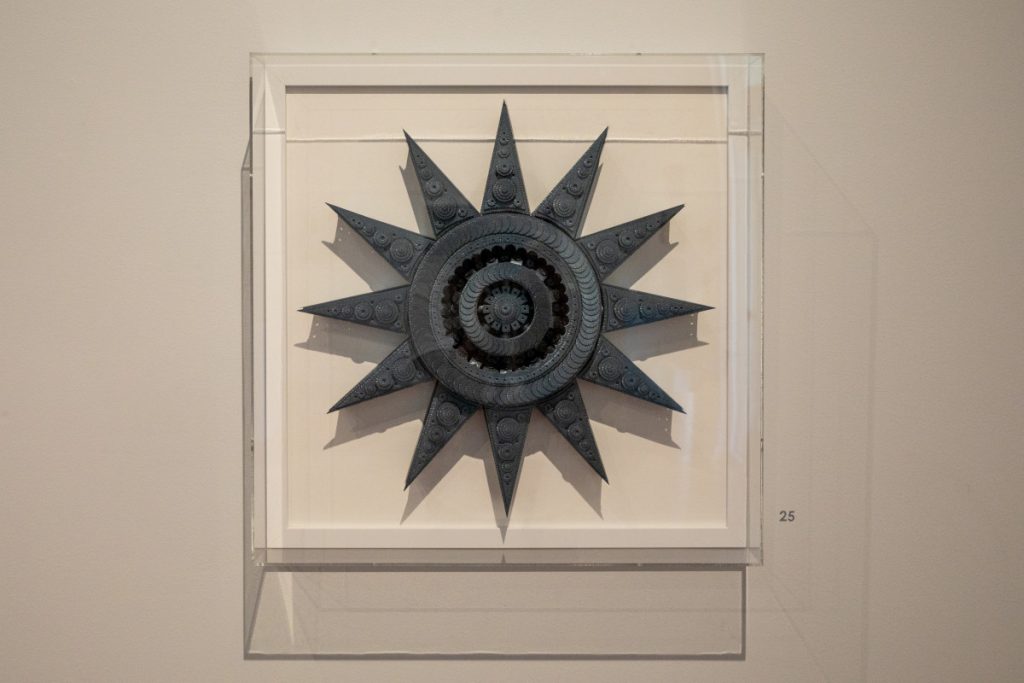
“Paper was always a component of the forms that I have made,” he said. “And the more questions you ask about it formally and technically always seem to have a unique solution, and that’s what led to the paper [art]works that are in the exhibition — it’s sort of the fullest expression of that idea.”
Velliquette’s sculptures start with a vague idea about a small, singular shape, perhaps a diamond or circle. He keeps no result in mind, but rather allows an improvisational attitude to take root. The results are unique, three-dimensional metallic-coated paper structures.
“What I’m interested in with this particular body of work is the paradox of knowing that what we expect to appear as timeless is actually made from something that is seemingly ephemeral,” he said. “It’s sort of the joy and magic of the process — like, ‘Wow, what can paper do?’” he added. “Can I continue to try to make it into the form that I envision? Being able to attain that is the challenge — the fun challenge, which is why I keep doing it.”
Velliquette’s pieces are actualized in a slow process that can sometimes take months to complete. His practice is a full-body immersion, a deliberate letting-go of the world to be entirely present with the work.
“Looking seems to happen at a distance, but it’s all actually happening in our minds,” he said. “Everything is mediated through our senses.”
Through his eyes, beauty, art, construction and deconstruction are interconnected concepts that loosen the shackles of ego and dissolve the harsh lines between subject and object.
The investigation of art remains as central to the viewing experience as the appreciation of it, and within the bounds of “Cutwork,” viewers have the opportunity to see the investigation as artwork in itself.