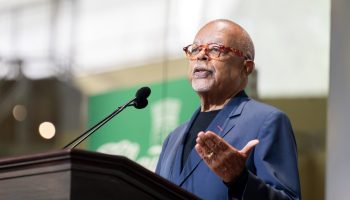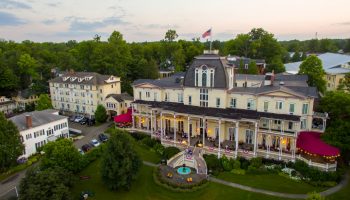

Gov. Alfred “Alf” Mossman Landon speaks August 24, 1936 in the Amphitheater.
Column by John Warren
Ninety years ago, the staff of The Chautauquan Daily was dealing with a daunting story budget of big-city-newspaper proportions. In the closing weeks of the season, the grounds would host separate appearances by a sitting U.S. president and his chief opponent in the 1936 general election.
One would think the star of the proceedings was the über-popular sitting president, Democrat Franklin Delano Roosevelt, still riding high on the popularity of the first and second New Deals.
But FDR ran second to his Republican opponent, Kansas Governor Alfred “Alf” Mossman Landon. Second, that is, only in the esteem of Chautauquans. Nationally, Landon would go on to suffer a shellacking of historic proportions, losing the electoral college vote by a margin — 523 to 8 — that even our current president would blush to summon from his imagination.
But in the eyes of Chautauquans, Landon’s appearance was a homecoming. “The First Son of Chautauqua” is how the Daily repeatedly referred to Landon in August 1936.
Landon had deep roots at Chautauqua Institution, going back to the first Assembly. In 1874, his maternal grandfather, the Rev. William M. Mossman, who was president of the Men’s Club, leased the platform tent at 20 Miller Park.
It was later passed on to Alf Landon’s father, John Mossman Landon, and Alf spent his childhood summers at the cottage, beginning at 18 months old. There, he became acquainted with Margaret “Peggy” Fleming, a neighbor across Whitfield Avenue at 22 Miller Park. She would become his first wife (she died during the flu pandemic of 1918).
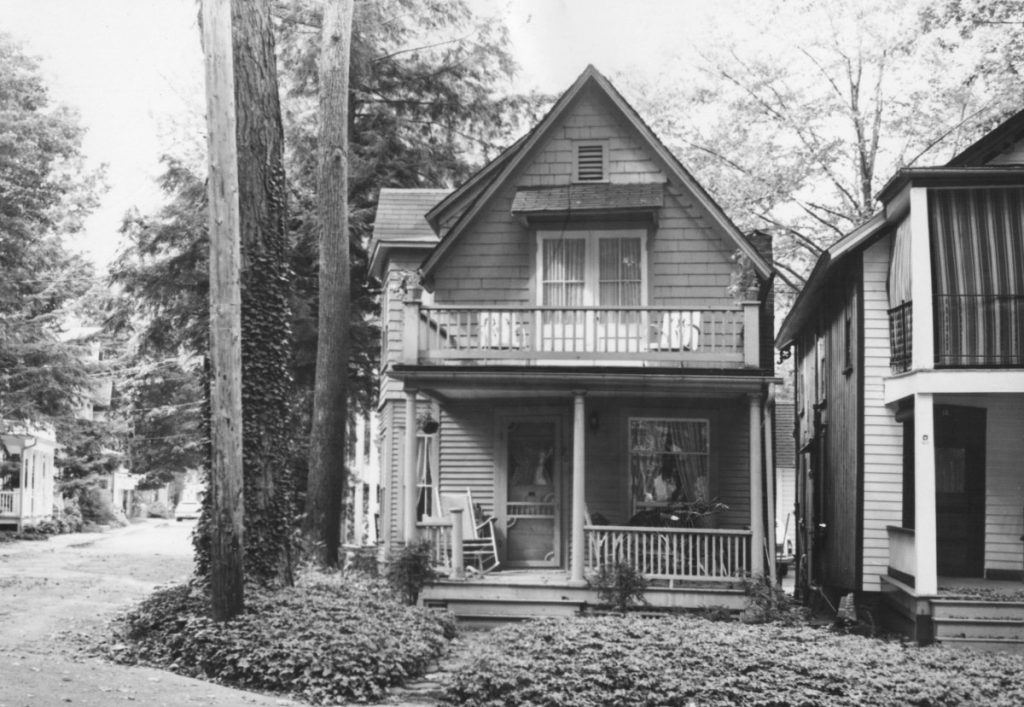
The Landon cottage at 20 Miller Park was originally leased as a platform tent by Landon’s grandfather. It was later passed down to his father and is where Landon spent his summers.
Friends remembered Alf spent his summers swimming, boating, horseback riding and “picnicking” from 1889 until he became governor of Kansas in 1933. He sometimes stayed at the Landon cottage at 20 Miller Park (which remains), and sometimes rented one of a number of other cottages.
Roosevelt’s speech that summer came first, on Aug. 14. The president’s train pulled into the Mayville station from Cleveland at 7:39 p.m. that day, greeting by flags and buntings everywhere. A motorcade of three state troopers led him to the grounds.
Led by Chautauqua President Arthur E. Bestor, the Amphitheater crowd waved thousands of white handkerchiefs to greet the 32nd president. George William Vokel played selections on the organ, and Walter Howe led the audience in community singing. Flash bulbs burst all around him, a battery of press men crouched around the stage.
It was the culmination of 20 years since FDR had first visited Chautauqua — his wife, Eleanor visited eight times, often engaging with the Women’s Club during her stays. This would be one of Roosevelt’s most famous speeches — “I Hate War” — delivered at the Amp, and it drew 12,000 people.
“I have seen war. I have seen war on land and sea. I have seen blood running from the wounded … I have seen the dead in the mud. I have seen cities destroyed … I have seen children starving. I have seen the agony of mothers and wives. I hate war,” he told the assembled crowd in the oft-quoted text.
He emphasized the isolationist sentiment that was deeply popular at the time, but would bring increasing scrutiny on the U.S. in the coming years: His determination to remain neutral.
“If we face the choice of profits or peace, the nation will answer — must answer — ‘we choose peace’!”
The Daily article ended by listing the names of every one of the dozens of “notables” who had been invited to sit on the platform for Roosevelt’s speech.
Landon’s speech came next, on Aug. 24. After arriving by train in New Castle, Pennsylvania, he motored to Westfield and then crossed the Chautauqua’s threshold at 6:27 p.m., had dinner at the Bestor residence with about a dozen old friends and headed to the Amp.
Landon pulled a crowd 50% larger than FDR’s: 18,000 people. The Amp had only 7,000 seats.
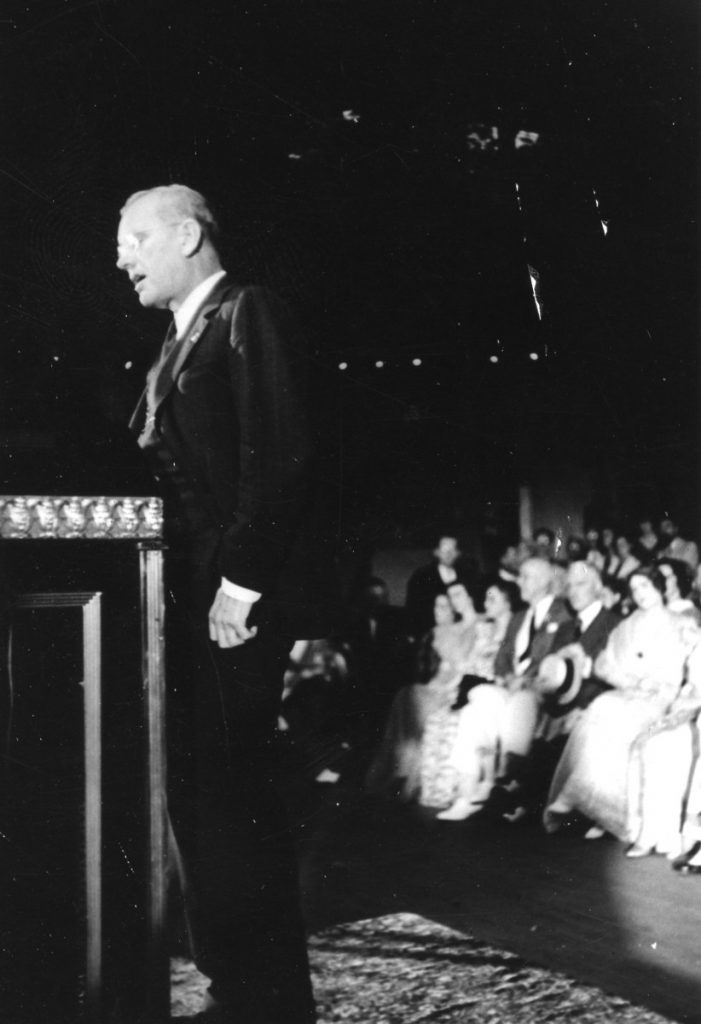
Landon delivers an address in 1936 in the Amphitheater. That year, Landon ran as the Republican candidate for the presidency against Franklin Delano Roosevelt. Landon served as governor of Kansas from 1933 to 1937.
Organist George William Volkel and song leader Walter Howe again did their thing, Bestor led the crowd in the Chautauqua Salute, and out came the hankies. “First Son Is Tendered Most Enthusiastic Chautauqua Salute by Largest Audience to Attend Event Here,” the Daily headline sang.
“In view of the great contribution Chautauqua has made to American life, I was glad to accept your invitation to speak,” Landon began to the crowd, which included scores of newspapermen, including the great H.L. Mencken, puffing on a cigar and wearing his trademark tortoiseshell glasses.
Landon praised the Institution for its contribution to American civic and educational life, but warned that democracy was threatened not only by foreign ideologies but also by government propaganda and efforts to manipulate public opinion.
“With understanding and intelligence, our future citizens will be able to separate truth from the ever-increasing amount of propaganda,” he said.
It reflected his concerns about the expansion of federal power under the New Deal, the rise of misinformation and the importance of civic education as Europe drifted toward World War II.
He concluded that the American people may remain masters of their own future, but only if they preserve education capable of producing informed, independent citizens able to defend democratic government.
The Daily article concluded, again, listing the dozens of “notables” who shared the stage with Landon. Many of the names were the same as for FDR’s speech. But there were noticeably more of them.
Postscripts and pleas: It was not the last appearance on the Chautauqua stage by a Landon. Alf Landon’s daughter, Kansas U.S. Sen. Nancy Landon Kassebaum Baker, later spoke at least twice on the grounds when she was an active senator, in 1988 and 1993. Kassebaum Baker survives; she is now 93.
Do you know someone who was there for FDR’s or Alf Landon’s speeches?
John Warren’s family landed in Chautauqua in 1956. Email him at historiographical@gmail.com.