Nora Smith
Staff Writer
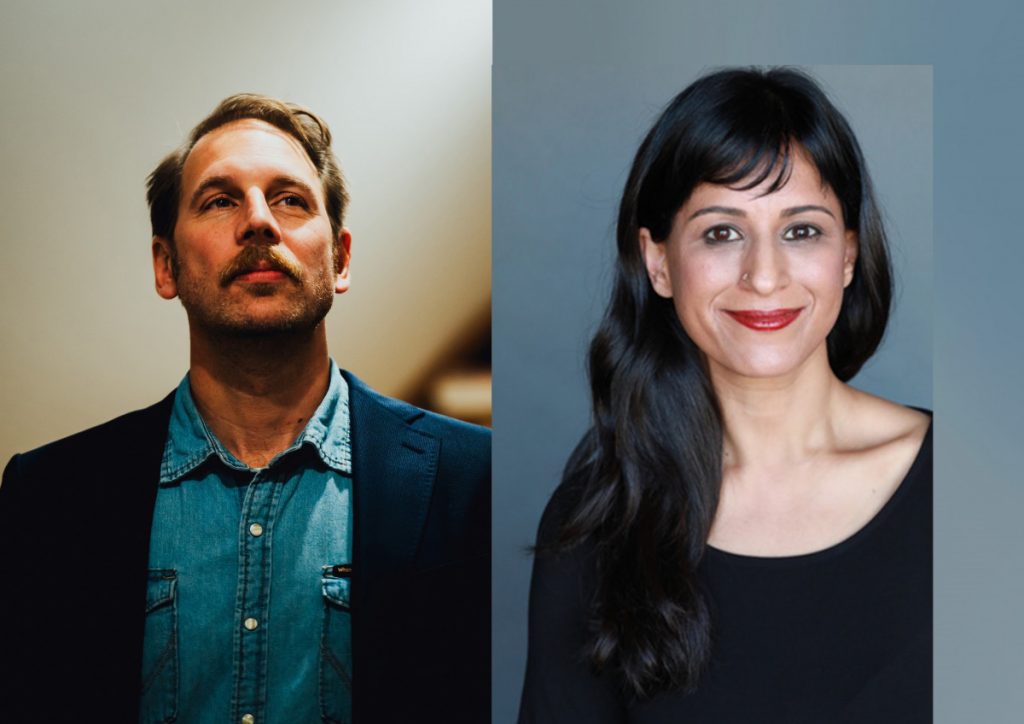
Noah Falck and Dr. Sunita Puri both walked untraditional paths to becoming writers and now work with writing in ways that extend beyond paper and into the human psyche.
For poet Falck, writing is an escape in the art of observation and attentiveness, where time slows and genuine human experience is summoned back from its hiding place.
“There’s an anxiety in our culture, and it’s just being normalized,” Falck said. “Poetry allows you to sort of stop, slow down, notice, think about time differently. All that stuff is really important, I think.”
When Falck was an undergraduate, he took courses in poetry; its ability to change a reader sought him out and hasn’t let go since.
“I vividly remember reading Charles Simic’s poem ‘Stone’ and being like, ‘How did he do that? I want to try to do that,’” Falck said. “It sort of made me on this lifelong journey of trying to figure out how to do it, and I still feel like I’m not quite there after 25 years of messing around with language.”
Puri, author and associate professor of medicine at the University of California, Irvine School of Medicine, is the director of Inpatient Palliative Care Service. Writing grants her the ability to carry the pain and beauty of vulnerability to the page in hopes of befriending grief.
“I think I always was a writer who became deeply committed to medicine,” Puri said. “I have always been a really voracious reader and writer, though I didn’t think I had what it took to make it as a writer. But within medicine, I found a specialty that truly allows me to engage with human suffering in a way that I find deeply fulfilling.”
Both Puri and Falck are returning to Chautauqua for Chautauqua Writer’s Center free faculty reading at 3:30 p.m. Sunday in the Hall of Philosophy, followed by a book signing. In addition to the reading, both writers will host individual workshops next week where they will encourage participants to experiment with vulnerability and get their own voices onto the page.
For Interim Michael I. Rudell Director of Literary Arts Stephine Hunt, Puri and Falck immediately came to mind when she considered who she wanted to return this year.
“I hope that [Chautauquans] come into the reading willing to hear and excited to take away from a varied conversation on media and mediums and how writing interacts with different variations of media, or how it can be transformed by different life experiences,” Hunt said. “How we can translate different human experiences into the medium of writing.”
Falck and Puri both pay careful attention to the act of crafting language and analyzing how that fabricates the human experience. This is something Hunt hopes audience members and participants embrace.
Through Falck’s journey in writing, he discovered that when gathering various art forms and working with them in the same vicinity, they’ll often collide and bounce off one another, providing a whole new perspective of the world.
“I’m also just interested in how, when all those things come together in general, how they give you sort of different sightlines on the world,” Falck said. “Which is to me, the most exciting thing. I love music, I love art, and I love poetry and life. How can all those fit together in a way that could open a different conversation?”
As a collector of sentences and images, Falck then translates what he’s taken from the world into writing and gives them back to the world in a voice of his own. This ability to take images and then voice them in a different light is something Falck plans to foster during his generative workshop.
“Poetry As an Act of Attention” will take place from 8:30 to 10:30 a.m. Monday, Wednesday and Friday, from July 6 to July 10 in the Literary Arts Center at Alumni Hall Poetry Room with an enrollment fee of $145 and cap of 15 participants.
“[Art] is changing you,” Falck said. “It’s a part of you, and I think art — at its best — does that, and it changes people for the better or at least opens them up and gives them new ways of looking at things or empathetic ears and eyes, and it just opens up the possibility of larger acts of joy and discovery.”
By looking closely at poems and having participants then pick out what stands out to them, Falck hopes this act of attentiveness will propel the participants’ own voices onto the page and give them space to look at things differently than they’ve been looked at before.
“How do you look out your window or notice something; how do you make it interesting and in your own voice?” Falck said. “There’s a different way of looking at the same thing over and over, and I think good art is like opening that door to seeing it for the first time.”
Not only will participants study examples of writing, but Falck also plans to have them spend time with other forms of media such as older films and music to see what worlds can be brought to life from those already existing art forms.
For Puri, on the other hand, the focus on language is central for both mediums of her work, and the deep attentiveness and observation writing requires makes her a better writer and doctor. This attentiveness shows itself when she meets with patients; Puri takes the time to observe features like their physical wellbeing, whether they or their family are in distress and what is said but also what is unsaid.
“My observation of the dynamics between people helps me to understand how they are navigating everything that dying brings: grief, regret, anxiety, but also love and joy,” Puri said.
Through writing and reading, Puri believes the inescapable topics of grief and illness can be better understood and can even make someone feel not so alone.
“There is a way through writing not just to understand your grief, but perhaps to befriend it,” Puri said. “And that is what I hope for my students and myself — that the pain on the page becomes a new and compassionate way of understanding ourselves.”
Puri’s generative workshop “Memoir: Writing the Experiences of Illness and Grief” runs from 3:15 to 5:15 p.m. on Monday, Wednesday and Friday from July 6 to July 10 in the Literary Arts Center at Alumni Hall Prose Room. She hopes to help participants to reframe writing as a companion.
“I am here to support you in finding words that have been elusive to commit to the page . . .” Puri said. “You are the only one who can tell your story. And I want people to feel empowered by that, not scared of it.”
The workshop has an enrollment fee of $145 and a maximum of 15 participants, and Puri plans to guide participants through prompts as she helps them feel comfortable enough to tell their own story, however frightening it may seem.
Although both Puri and Falck find true humanity in different ways throughout their writing, they both view the media as something that can transmit change and understanding. That is exactly what they’ll bring to Chautauqua.