
LAYLA VINSON
Staff Writer
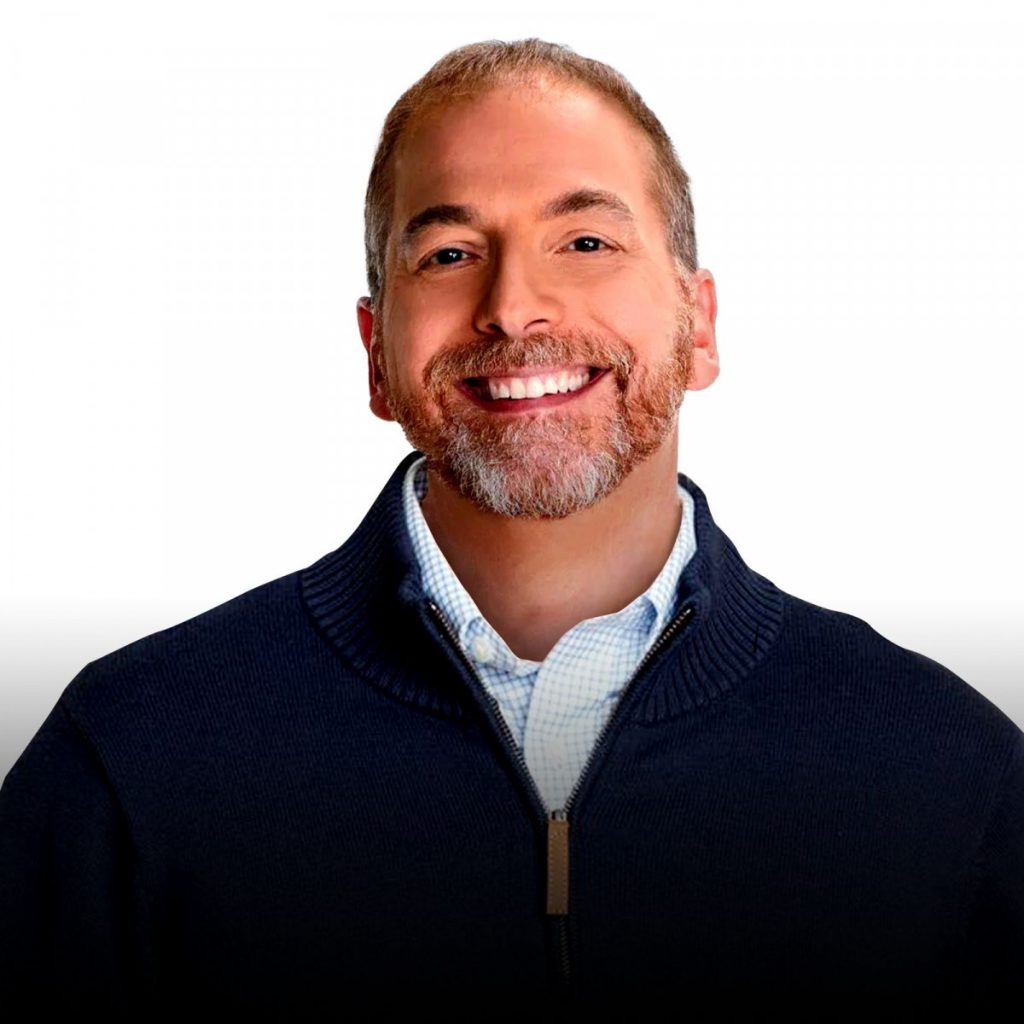
Blazing a trail through an ever-evolving digital ecosystem, media and political analyst Chuck Todd will share his expertise on the news media industry with Chautauqua Institution at 10:45 a.m. today in the Amphitheater. Highlighting the cyclical nature of paradigm shifts within society, Todd speaks to Chautauqua’s Week Two theme, “Breaking the News: Charting a New Media Landscape.”
“New technology comes along, there’s fragmentation, then there’s consolidation, then there’s new technology and we start all over again,” Todd said on the topic of a podcast episode he released relating the technological revolution of today to the Industrial Revolution.
Planting his early roots, Todd developed extensive startup experience in his formative years by working for a small publication on the precipice of the newsletter world, The Hotline. In 2007, he moved to NBC as a political director and later to chief White House correspondent before beginning perhaps his most famed journalistic work as moderator of Meet the Press from 2014 to 2023.
“I always joke that Meet The Press will be on my obituary,” Todd said. “… But my formative years, the skills that I learned, the things I learned about media, print, digital, television in that era of web 1.0 to 2.0 transition, I constantly go back to lessons learned from that period.”
After Meet The Press, Todd continued his work with NBC during a brief stint as chief political analyst before ultimately stepping down in January 2025 and leaning into his entrepreneurial endeavors for “The Chuck ToddCast.” In an interview with USA Today in 2025, Todd underscored growing media distrust and his experience capitalizing on innovative opportunities as his reasoning for his transition toward professional independence.
Civic skepticism toward highly curated news has only been further substantiated in Todd’s perspective as he navigates what media formats garner the most engagement. To him, the content he puts out that performs best in terms of metrics and engagement statistics tends to be informal and casual. When he’s recording on his phone or not on his podcast set, he explained, the informal nature lends
itself to authenticity.
“And what does that tell me?” Todd said. “It only increases authenticity to people, right? Something that looks less put together, certainly informational — you’ve got to provide them something — but there’s certainly more credibility that comes with the less formal it is.”
As the line between the political and media environments become increasingly intertwined, Todd hopes to address that intersection and the festering wariness of the public. Extremities in partisan parties have led to an increased desire not only for independent news, but elected officials, with a Gallup poll published in January of this year claiming a record-high 45% of U.S. citizens identifying as politically independent.
“I think as long as you have such a powerful polarizing force that is Donald Trump, it is hard for a third entity to break through,” Todd said regarding the rising popularity of the independent party. “The thing is that Trump himself is such a lighting rod that until he leaves stage — I happen to think that literally as he leaves the stage — that’s when the fragility of the two parties becomes vulnerable to an independent or third party. But right now, too many people view it as either ‘I’m voting for Trump or against Trump.’”
Todd went on to express his distaste for current decisions in Congress, referencing Tip O’Neill as potentially the last Speaker of the House more loyal to the institution than to a party, highlighting volatile back-and-forth conflict between both major political parties as the catalyst for such circumstances. In hopes of bridging the societal divide forming in accordance with the polarizing political climate, Todd continues to seek out the best way to share his research and insights with audiences.
Deeming video as the new currency, as opposed to written word, Todd’s adaptability in an ever-changing industry has been crucial in amassing his success, but he views some emerging ideas as more favorable than others. As artificial intelligence seeps further into journalism, Todd identifies opinion and individuality in writing as what prevents stories from becoming “white noise.”
“If AI writing becomes the norm, I don’t think anybody will read anything because everybody will write with the same voice, everybody will write with the same tone,” Todd said. “I think AI is a research tool. The human interpretation is the differentiator. And if you go to AI writing, you’ve gotten rid of the human differentiator.”
Whereas others might view this disruptive phase in media as a time to shy away from the field, Todd encouraged journalists to push their apprehension to the side and welcome the opportunities an unstable industry could potentially provide. Todd explained that his openness to failure provided a gateway to try new things, experiment and be open to new pathways in the industry.
“I don’t know whether I’ve got an eye for it or I’m just sort of not afraid to try. I’m not afraid to fail. Well, we’re all afraid to fail,” Todd laughed. “But the point is that it’s okay to fail.”