ARIANNA NEVAREZ
Staff Writer
After receiving hand-me-downs that were no longer in style, Aja Barber started buying her own wardrobe. As she increasingly saw clothes priced at low numbers, she began to wonder how people got paid to make these items. She learned they don’t, and she decided to speak up.
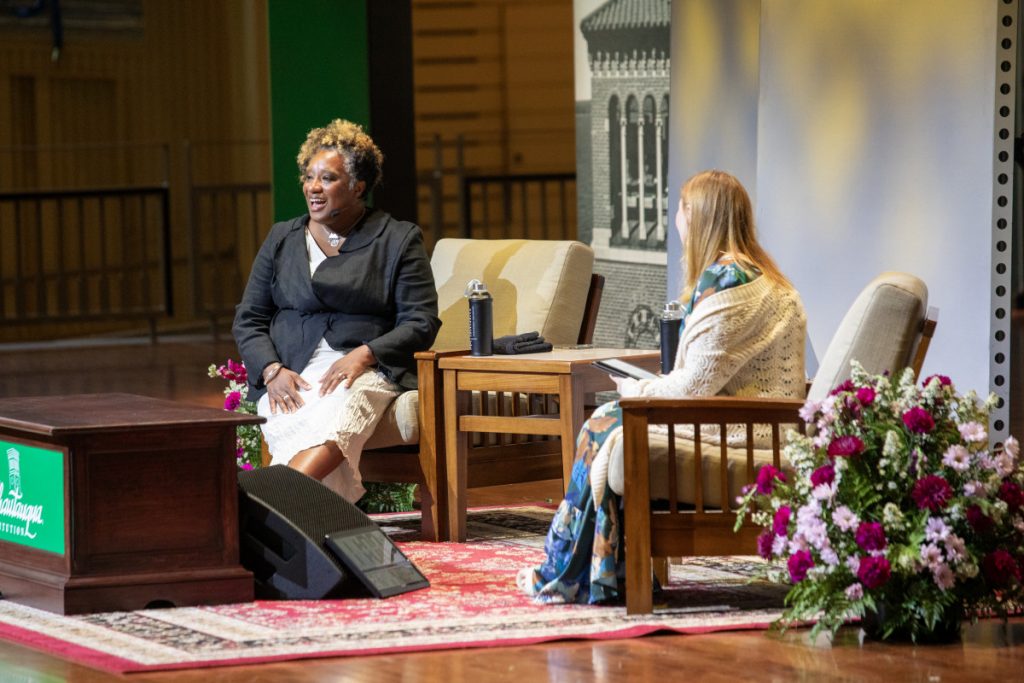
At 10:45 a.m. Tuesday in the Amphitheater, writer and sustainability consultant Barber addressed fast fashion and its negative effects on consumers and workers alike. Barber’s work focuses on the intersections of sustainability, fashion and the textile industry. She also advocates for ethical fashion and fair treatment of garment workers within the fashion industry.
As Barber was growing up, she saw how quickly clothing styles and trends cycled. She volunteered at a charity shop where she saw the store receive loads of bags, “so much that it would almost hit the ceiling.” After organizing those, she said the next week, another load of bags would pile up. Barber said she started to feel like this was an “ecological disaster.”
“If everyone’s operating with these sorts of margins and turnover, there has to be something happening here that isn’t good,” Barber said. “Through the last 10 years, I’ve started to really pull apart the seeds of the system and understand that our clothing doesn’t disappear. … It becomes someone else’s problem. It ends up in someone else’s backyard. In addition to that, people aren’t being paid or treated nicely within the supply chain, and I just thought, ‘You know what? I don’t like this. I’m going to shout back on the internet,’ and that is why I’m here today.”
In Consumed: The Need for Collective Change: Colonialism, Climate Change, and Consumerism, her debut book, Barber relays a multitude of stories and combines them with research to argue for change in the fashion industry. As a young Black woman, she often didn’t see herself in many industries, so she ensured she included a variety of voices in the book.
Barber talked about the importance of accessibility in her books; she explained that she wants to ensure people can take something valuable away from her writing.
“The minute you start talking about climate crisis or science or even fashion, it can get quite technical,” Barber said. “If you want the general public to be brought in, we have to make it so that people feel you can meet them where they’re at.”
The fashion industry accounts for between 8% and 12% of global carbon emissions, according to Barber. Though this is “not fun and downright can be quite scary,” she said consumption is an area where society has the power to “change the system.”
Social media influencers have contributed to a fast fashion pipeline, Barber said, but she also said “the speed of everything that’s happening” and “the systems” are at fault. She cited a New York Times article from a few years ago that said: “The average young person feels like if they’ve worn an outfit (and) it’s been seen on social media, it is now considered very old.”
As clothing demand rises at faster rates, Barber said people need to think about who is producing the products. She said people in the Global South are usually “making pennies” and “unlivable wages.” Barber said companies will go to different factories to see who will do their work for the lowest price, in what she refers to as “the race to the bottom.”
Barber said people are not only being taken advantage of, but the overproduction eventually comes back to their countries. The Citarum River in Indonesia, which is close to clothing factories, changes colors “based on what is in season in the fashion industry,” she said. She also said that, though America has labor regulations, work is being outsourced, and unsafe labor is happening in other countries.
“The speed at which we see things in stores has exploitation behind it,” Barber said. “There is no way that things can move as quickly as they move without someone being exploited. Every time you go into a store on the high street, and there’s new stuff in there, it’s because someone has been exploited.”
While clothing production is faster, Barber said the quality of the products goes down. She said polyester is increasingly common, and 60% of what’s being produced is polyfiber, which could take “2,000 years to biodegrade,” according to Barber. She also referenced a Canadian study in which clothes from Shein were chemically tested; it turned out they had five times the legal limit of lead.
“If you were producing clothing in Canada, it would not be on the shelves, but if you just buy it from Shein, you can do that, and that’s what young people are doing,” Barber said. “They are putting that on their body, and the poor workers that have to work with it. As we know, your skin is one of the biggest living organisms on our body. What impact is that having on us?”
To be more sustainable when shopping, Barber said people can look to companies’ ethics in how they pay their workers. She said, “Brands that actually care about fair treatment of the workers also care about the environmental impact.” As people start to think deeply about the companies they buy from, Barber said it takes consumers out of the “overconsumption sphere.”
In closing, Barber said the fashion industry produces 100 billion garments annually. She said people don’t need “millions of garments that are going to be trashed.” She said garments that last, can be repaired and passed on for generations are what’s needed.
She pointed out the Speak Volumes campaign, led by the environmental justice nonprofit The Or Foundation, “which encourages corporations to be open about the volume of clothing they’re producing.” She said very few companies are transparent, yet it is important to hold them accountable.
“The volume of clothing that’s being produced is horrific, and if there wasn’t so much being produced, I would argue that a lot of these corporations could afford to pay the garment workers higher wages,” Barber said. “If you’re not wasting and making millions of garments that you hope you might get people to overconsume and fill their closets with, then maybe you can pay higher wages. Maybe it’s not that impossible, right?”