

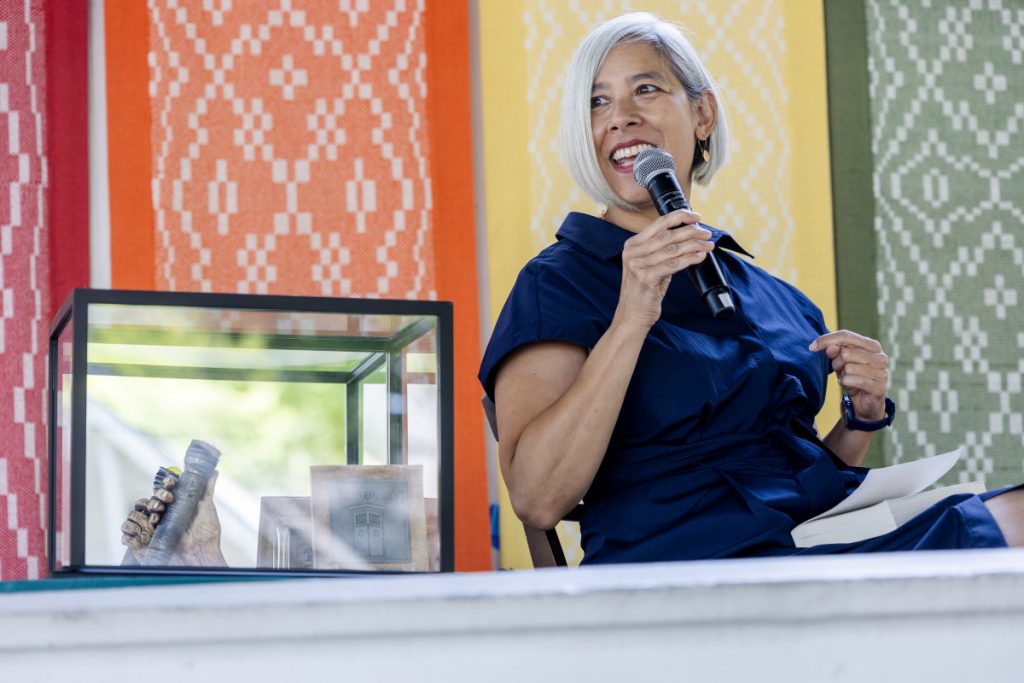
Author Susan Choi speaks about writing her Chautauqua Prize-winning novel “Flashlight” during the 2026 Chautauqua Prize Ceremony Friday in the Hall of Philosophy.
NORA SMITH
Staff Writer
In deciding on the Chautauqua Prize winner, readers immerse themselves in a literary experience unlike any other, opening worlds and concepts that expand even the author’s understanding of their own work.
Former CLSC author, Writers’ Center guest faculty member and, now, 2026 Chautauqua Prize winner Susan Choi returned to Chautauqua Institution at 2 p.m. Friday in the Hall of Philosophy, where she was presented with this year’s prize: a handmade ceramic sculpture created by Chautauqua Visual Arts Visiting Artist Rick Sullivan.
After the physical prize — a hand holding a flashlight upward — was revealed, Interim Michael I. Rudell Director of Literary Arts Stephine Hunt began the onstage interview, first asking what the prize means to Choi and her relationship with Chautauqua.
“I’m just having a real sort of giggly moment of elation to be sitting here, and I keep reminding myself that you’re awarding me this incredible honor, which really means so much to me …” Choi said. “I really think the prize is very unique in the landscape of prestigious literary prizes. It feels, too, like the one that represents a community of readers.”
The discussion then led Choi to talk about how she was first inspired to write Flashlight after visiting Japan in the late 1970s during her childhood. The trip was uneventful, unlike the plot of the book, but it still impacted her greatly.
“Being transported to that culture and landscape was unforgettable for me, and I always wanted to use it in a work of fiction but knew I needed more story than I actually had from experience, and so it actually took most of my life to date for me to come up with a story,” Choi said.
In addition to Choi’s own trip to Japan, she said her father was an immigrant from Korea, which caused an interest in the region and resulted in her discovering its history before she even realized.
“There was a lot of research that unfolded before I even knew I was researching this book, and then once I started putting the storyline together, then there was a whole second wave of, ‘Oh, now I actually really need to nail these facts down,’” Choi said.
Choi then explained her process of writing such a genre-bending book, how she got to know the characters and how they surprised her throughout the writing process. She also discussed how she came across major themes in Flashlight, most of which Choi said she didn’t realize until readers brought them to the story through their own reading experiences.
As a writer, Choi said she doesn’t find herself conscious of crafting long-form metaphors or thematic throughlines; instead, it’s often something readers point out to her later on. For example, Choi said Flashlight began as an exploration into a family’s complex relationship but ended up involving lots of big picture themes.
“Luckily, readers are so smart and bring a lot to the books, and as I was kind of building a book, I felt (it) was really about relationships,” Choi said. “Those relationships ended up pulling in a lot of big world stuff, having to do with language and national identity and memory and how you conceive of yourself and the self that you show other people.”
After reading an excerpt from narration of the character Anne, Choi answered questions from both the live and online audiences about characters in the book, how the settings came to be, her writing environment at the time of the book and where her work may take her next.


