ROCCO PRIOLETTI
Staff Writer
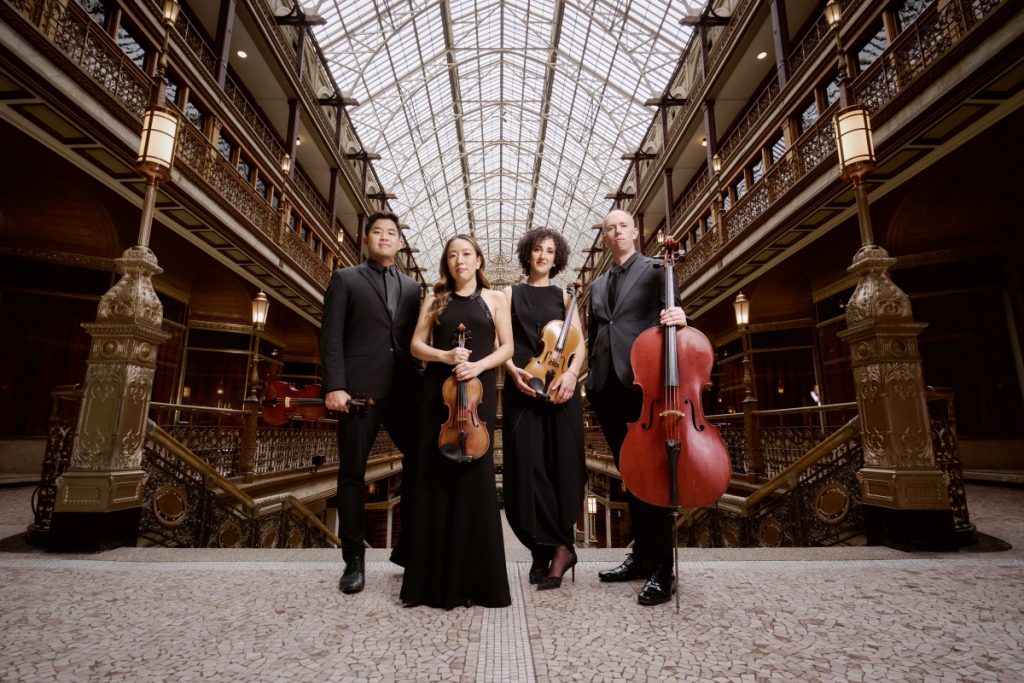
For Jonathan Dormand, Verona Quartet’s cellist, the sheer possibilities of a string quartet underpins their performance.
“… Unlike a whole orchestra, for example, where there are sort of endless combinations of different colors, … with us, we want to be able to make a program that, with four instruments, also gives that possibility,” Dormand said.
At 4 p.m. today, Verona Quartet will make their Chautauqua Institution debut in Elizabeth S. Lenna Hall.
Verona Quartet’s program, titled “Inflection Points,” focuses on the progression of string quartet writing every 100 years.
Alessandro Scarlatti’s 1720 piece, Sonata a Quattro No. 4, acts as both the program’s opening statement and the inception point for the genre at large. Dormand called it “possibly one of the very first ever imaginings for string quartet.”
“The Scarlatti [piece] was a particular[ly] wonderful find because we don’t have, as quartet musicians, very many opportunities to delve into Baroque music. It’s really been like a treat to explore that side about playing,” Dormand said.
Austrian composer Joseph Haydn is remembered as the “father of the string quartet” for his influential works from 1750 onwards, which spawned the genre. This makes Scarlatti’s quartet, composed decades before Haydn, notably groundbreaking for its time.
Verona Quartet makes an effort to highlight uncommon quartet repertoire — like a contemporary piece composition by Augusta Read Thomas — while simultaneously performing “cornerstones of the quartet literature.”
Leoš Janáček’s String Quartet No. 1, “Kreutzer Sonata,” tells the eponymous story by Leo Tolstoy in musical form. Dormand highlights the “very dramatic” ending of the story in which a man kills his wife.
“The thing that’s interesting about this music is that it doesn’t tell the story from a programmatic point of view; it more is a reaction to the emotional feeling of what the story is telling you as you would read through it,” Dormand said.
Storytelling comprises another throughline to the greater narrative of “Inflection Points.”
The program’s arc crescendos into Ludwig van Beethoven’s String Quartet No. 12, Op. 127. Dormand called Beethoven “the ultimate protagonist for the string quartet.”
“The Beethoven [piece] is sort of one of the ultimate thoughts, even today, of what is possible for musicians coming together,” Dormand said.
Despite the quartet each individually deriving from unique backgrounds, cultures and locations, Dormand viewed music as Verona Quartet’s unifying bond.
“We’re very fortunate to have each other, because we have an equal passion for what the string quartet is all about,” Dormand said. “… We speak to each other through that common language of music and the artistry of what we’re playing.”
Dormand’s passion for the cello arose during his upbringing in England when his first cello teacher brought him to a cello festival in Manchester.
“The nearest city to where I grew up — which is Sheffield, in England — didn’t have a professional orchestra. But, we did have a professional string quartet that was in residence, called the Lindsay String Quartet,” Dormand said.
Hearing these performing cellists sparked his interest in string quartets.
“From a very early age, I always wanted to be a quartet cellist,” Dormand said. “So, I feel so happy that it’s something that I get to be able to do.”
He relayed that tonight’s performance marks the quartet’s first visit to Chautauqua.
“We’re really excited to be there, and we’ve been hoping to come for many years to Chautauqua,” Dormand says. “Because we live in northeast Ohio now, we’re kind of relatively local. And so, we’re very, very excited for our first visit to the Chautauqua [Institution].”