NORA SMITH
Staff Writer
Today, no living person can recount what it was like to live during the American Revolution and the smallpox epidemic, and a century from now, few will be able to recount the experience of disinfecting groceries, keeping a distance of six feet and the fear that a sneeze brought to a crowd during the COVID-19 pandemic.
Luckily, there are written works that tell the stories of these times past, whether through firsthand experiences or through meticulous historical research.
Adrian Matejka, award-winning author, poet and current editor-in-chief of Poetry Magazine, unknowingly buried a time capsule by spending the entirety of the COVID-19 pandemic writing poems. Laurie Halse Anderson, a New York Times bestselling author, went back in time to tell the story of the American Revolution through the eyes of a young girl in Boston during the smallpox epidemic after navigating her own experience during the COVID-19 pandemic.
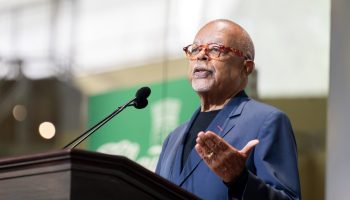
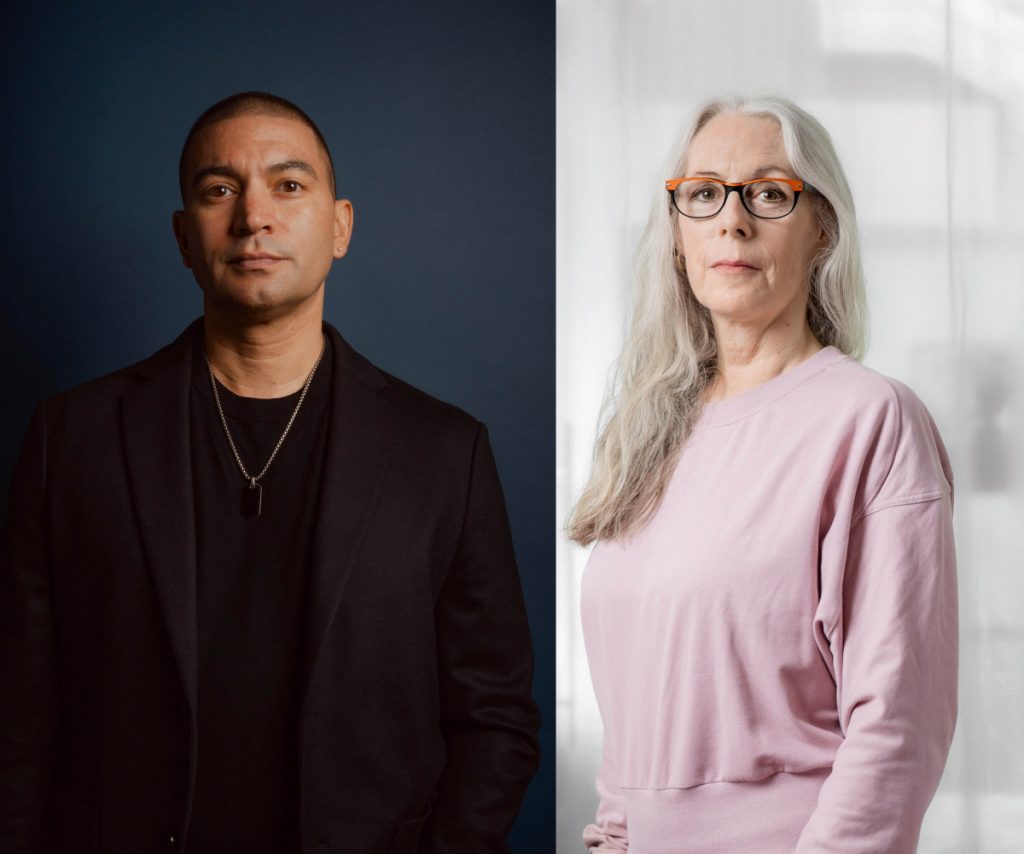
Matejka and Anderson will be in conversation via similar threads of history in their work during their respective presentations on their Chautauqua Literary and Scientific Circle selections at 2 p.m. today in the Hall of Philosophy.
With Matejka’s newest collection of poetry, Be Easy: New and Selected Poems, on the shelves since May, both the proof of when the world froze in time during the COVID-19 pandemic and the experiences and feelings of Matejka himself at the time are now immortalized through literature.
Be Easy houses six poetry books in one, with Matejka having written the oldest poem in 1993 before 9/11 and having written the newest poem right before the collection was published around 2023 and 2024.
Spanning more than 30 years, Matejka said the world is “just completely different” since the first book was written.
“So, to go back and look at them, there’s a little bit of naivete, both because I was very young writing them, but also because we were a very different country in 1993 than we are now,” Matejka said.
A section of poems in Be Easy, “Somebody Else Sold the World,” was composed entirely during the COVID-19 pandemic.
“I look back at it, and I was like, ‘Oh, it was so stressful, it was so terrible,’ and there were also these really bright moments, which I think is always true,” Matejka said. “Maybe that’s what poetry does, is poetry tries to find the bright moments even in the middle of the rest of it…”
Matejka said he often writes toward the past and on how he feels about his experiences in the present, but having written these poems during the pandemic, Matejka said they are living proof of the past and he is glad they exist so authentically.
“…I left all of it in the poems, even though we’d figured it out by the time the book was coming out, I was like ‘No, I want to remember how scary this was,’” Matejka said. “Because that also helps to try to frame the fact that we survived despite being kind of abandoned by the government, abandoned by some of our institutions, we did it anyway. We’re still here.”
In conversation with Anderson about her novel Rebellion 1776, Matejka said he thinks he’ll read some more historical work of his to produce “a more robustly American conversation.”
“…I’m always sort of mostly writing in the past anyway, but I’m so fascinated with the ways in which we can tell a truer version of the history we’ve been given, and I think that’s going to be a part of the conversation the two of us are going to have,” Matejka said.
According to a Q-and-A in Publishers Weekly, Anderson had been originally inclined to write a middle-grade adventure novel, Rebellion 1776, in 2020 when she herself had COVID-19 and noticed a similarity between then and the smallpox epidemic during the Revolutionary War.
“It’s good to read about intense events at a historical remove, especially when we’re going through intense events ourselves,” Anderson said in the interview with Publishers Weekly. “And really, we read history to help us understand our lives today. Once I started researching the smallpox epidemic of the 1770s, boy, did it feel familiar to where we were in 2020.”
In that same interview, Anderson said these historical events have a much larger impact on children than adults, and because children today are growing up in a time of uncertainty, it’s important to “spark their curiosity about our history” to help prepare them to navigate the future.
“It’s important to tell the history accurately, though,” Anderson said in the Publishers Weekly interview. “Generations before us didn’t tell the whole story; they mostly told the stories of rich, white men. Now, though, we have digital tools that allow us to access a variety of primary sources in a way we never could before.”
In an interview with PEN America, Anderson offered advice to young people: “When life is hard, books help.”
Later in the interview, focusing on book banning and the threat to children’s literature today, Anderson said, “It’s incredibly disheartening. It’s especially disheartening for me because in children’s publishing, we were just beginning to open the door to all kinds of authors, to all kinds of creators.”
When Anderson had COVID-19 herself, she began looking into Abigail Adams, who during the summer of 1776 underwent smallpox inoculation with her children. This event, 250 years ago, led to Anderson’s Rebellion 1776.
“I had to learn more about Boston in 1776 and I saw kind of a shadowy mirror that seemed very familiar, because it was a time of tremendous political divide, where families were being separated because of who they wanted to support, the king or new America,” Anderson said in the interview with PEN America. “And then there was this controversy about, do we get our children vaccinated, inoculated against smallpox, which also sounds very familiar.”
In that same interview, Anderson said as a writer in today’s political climate, it is crucial to “let the art bubble out of your soul,” and referenced Astrid Lindgren’s children’s novel Pippi Longstocking, written during World War II, that had inspired Anderson to become a “strong girl” herself.
“Now, Sweden wasn’t occupied by Germany,” Anderson said in the PEN America interview. “Their position was a little bit unique, but it was still a very scary and threatening and uncertain time. And so maybe times that feel challenging are the times that push us to create the art and let the art bubble out.”