
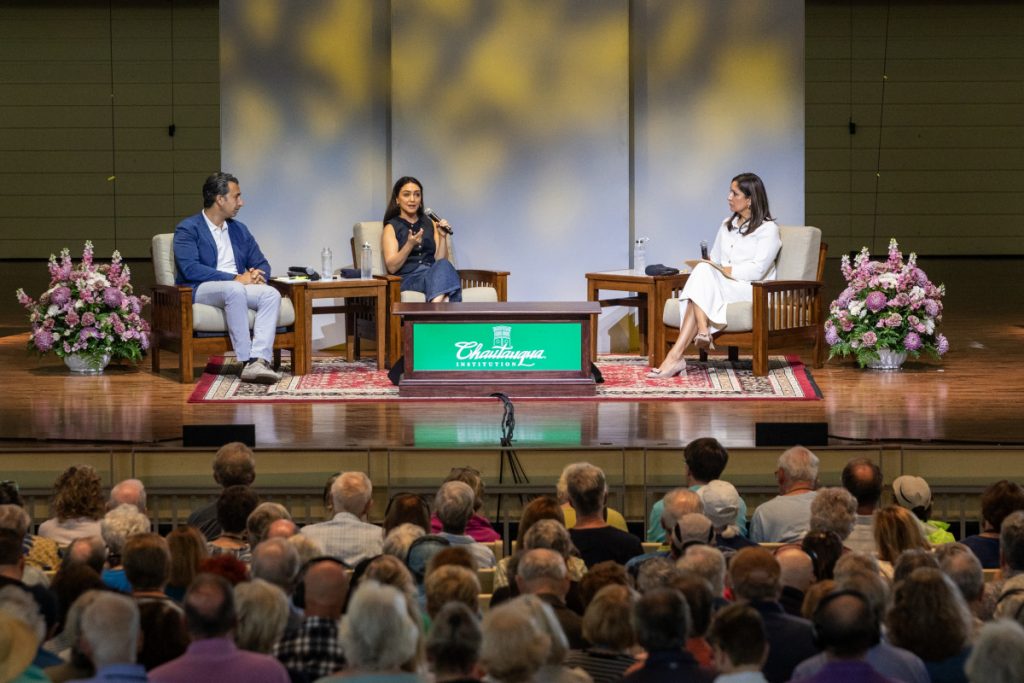
Actress and activist Nazanin Boniadi, center, joins in conversation with Karim Sadjadpour, senior fellow at the Carnegie Endowment for International Peace, and Amna Nawaz, broadcast journalist and “PBS News Hour” co-anchor, on the current state of Iran Tuesday in the Amphitheater.
ARIANNA NEVAREZ
Staff Writer
Though headlines about Iran focus on the Iran war, “PBS News Hour” co-anchor Amna Nawaz said the country of Iran is more than its wars.
At 10:45 a.m. Tuesday in the Amphitheater, Nawaz moderated a conversation with Senior Fellow at the Carnegie Endowment for International Peace Karim Sadjadpour and Nazanin Boniadi, SAG and AACTA Award-nominated actress, on each speaker’s connection to the country, the current state of Iran and the future of the Iran war.
Sadjadpour, a CNN Global Affairs analyst, said the war is discussed primarily in terms of modern technology, yet ancient emotions are driving and sustaining it. When President Donald Trump launched the war in February, Sadjadpour said Trump wanted to be the president to “end the humiliation” that Iran had caused the United States since the 1979 revolution and hostage crisis.
Sadjadpour said Iranians feel they have been humiliated by the U.S. over the decades and are seeking revenge for the assassination of their supreme leader, Ayatollah Ali Khamenei. These emotions are leading both parties to slow the ending of the conflict, according to Sadjadpour.
“I don’t see a conclusion to this war anytime soon. We will see moments where there’s kind of a lull in fighting, but it is simply going from hot war to cold war,” Sadjadpour said. “Right now, I think we’re in kind of a daily state of cold war. They’re blocking the strait. We have a naval blockade against them, and right now, it’s a test of will and a test of resolve.”
According to Sadjadpour, what matters most to revolutionary dictatorships is simply staying in power. He said the U.S.’s attempts to end the war with bombs and bribes will not help to end this quickly, because the Iranian regime can hold the most power by being isolated.
Boniadi, an activist who has been connected to Iranian civil society for two decades, shared her perspective regarding what she’s heard from Iranian people on the war and said the Iranian regime “does not care for its people.” She said Iranian people’s celebration of the assassination of their supreme leader was out of desperation.
The Trump administration sent a message that help was on its way, which gave courage and hope to the Iranian people, she said. Now, Boniadi continued, people have lost that hope and feel stranded after promises were not fulfilled. She said she talked to a mother in Iran who “said it best.” The mother said, “My children are afraid of bombs. I’m afraid for their future if this regime survives.”
“They feel alone,” Boniadi said. “They are caught between a rock and a hard place. Nobody wants war, but at the end of the day, who is going to get rid of this regime, a regime that just doesn’t care for the Iranian people?”
Iranian people were asked their feelings about the regime in a recent poll by the Group for Analyzing and Measuring Attitudes in Iran, where 25% of Iran’s literate population aged 15 and above admitted to protesting in January. Boniadi said that translates to about 14 million of a 92 million-person population. Overall, Iran is a country that has crumbling infrastructure and an economy that’s suffering due to “corruption, mismanagement and neglect.”
Nawaz asked both speakers about their connection to Iran. Boniadi talked about how her parents left Iran for London when she was only 20 days old. She said her parents saw the newly forming Islamic Republic and believed it was “going to destroy the country.” She said not many people at the time had the same foresight.
As she grew older, Boniadi said she had a desire to visit Iran, but her father wrote anti-regime articles, which made him a target. To visit the country, she had to lie about having no connections to her father. On her trip, she saw the “beauty of the people, the land, the culture and the history.”
Boniadi also interacted with what she said the Iranian regime calls the “morality police.” At 12 years old, she and her uncle were stopped by a plain-clothed militia who demanded they produce a marriage certificate. When her mother tried to protect Boniadi and explain the situation, the man threatened to arrest Boniadi and her mother.
“That was the experience that really informed my desire to want to support and advocate for the women of Iran,” Boniadi said. “… Once I started my activism, it becomes impossible; it would be a danger to me (to go back to Iran).”
Sadjadpour was born and raised in Michigan, but growing up in the aftermath of the Iranian revolution, he said, “The last place in the world you would want to be from in the 1980s is a country which has just taken American citizens hostage.” His Iranian identity became something he avoided.
After graduate school, Sadjadpour moved to Tehran, Iran, to experience the culture he had once distanced himself from. He found Iran unique due to it being a “very rich civilization” full of history, yet no one captured it because the country isolated itself through politics.
Now, as an analyst specializing in Iran, Sadjadpour said he has been told he should not return to Iran because he would be arrested on arrival. After learning this, he became blunt in his analyses, though this topic is part of his identity.
“When the topic you’re working on is close to your heart, there is a tendency… to conflate your hopes and your analysis,” Sadjadpour said. “I would like to see Iran become a better place, and therefore that was being reflected in my analysis.”
Boniadi said Iran has compiled a list of certain people and media entities, and if Iranian people send information to those identified they could face the death penalty. Boniadi is on this list, and therefore cannot visit Iran because of her activism.
Nawaz brought up how people in Hollywood often choose not to speak out due to losing a role or opportunity, but Boniadi said she worries more “about what the world would look like if [people] didn’t speak out.”
Sadjadpour said Iran has historically thrived where there are “chaos, war and weak states.” He said this current war is playing into Iran’s strengths and the U.S.’s weaknesses. When Trump keeps threatening to continue bombing Iran and destroy their civilization, Sadjadpour said Iran benefits from that instability.
Boniadi said Iran’s goal is to divide the Democratic and Republican parties and sow inner-party division. She closed by saying soft power is what is important, which includes the funding of human rights organizations and people who document abuses in Iran, so the Iranian regime can be held accountable when it falls, which Boniadi said will happen.
“The Iranian people will persevere. The question is, we’ll need to do everything we can to get them there; that doesn’t mean we need to bomb this regime out of existence,” Boniadi said. “That means being strategic in how we deal with this regime, to disempower the regime and empower the people for self-determination.”