
NORA SMITH
Staff Writer
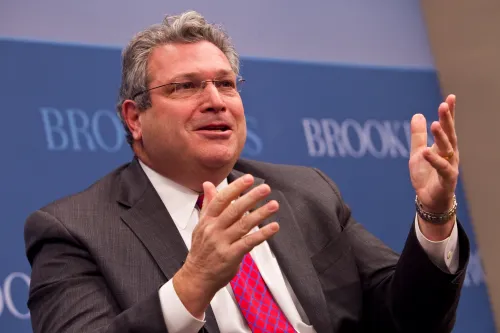
Robert Kagan, senior fellow at Brookings Institution, contributing writer to The Atlantic, member of the U.S. Department of State Foreign Affairs Policy Board and author of several books, including, most recently, Rebellion: How Antiliberalism Is Tearing America Apart — Again, will give a lecture at 10:45 a.m. today in the Amphitheater.
According to Rebellion’s book description, Kagan warns readers of a current threat to democracy by recounting the history of opposition to liberalism and government while relating it back to today’s political state. The book’s description reads, “This is an elegant and deeply informed synthesis of history, contemporary politics and ideas that sheds light on this crucial moment.”
In an interview with Bill Kristol in 2024, Kagan said he was trying to answer a question in Rebellion: “Why are so many people supporting a guy who evidently wishes to overthrow the nature of our system? A guy who has proven to be willing to be a dictator… ” Kagan said.
The answer to this, Kagan said in the interview, is that a large group of people aren’t just following President Trump blindly; they are a part of “a very powerful movement that supports Trump that really would like to see a change in the way America operates.”
In addition to Kagan’s most recent book, his profile page on Brookings Institution’s website reads that he has expertise in U.S. foreign policy and international relations, in addition to research areas in defense and international affairs. Some of Kagan’s most recent work centers around the war in Iran and the redistribution of international power.
According to a recent conversation with Brookings Institution’s “The Beijing Brief” podcast in an episode titled “Will China replace America on the world stage?” Kagan started a project at Brookings Institution titled “Blowback: How the Iran war may change the world.”
“Well, in my mind, this is part of a broader effort to sort of really look at where things may be heading, now that we are in a period of what I regard as probably radical change rather than incremental change; that, largely because of American actions, we’re having a real redistribution of power, real questions raised about security by a lot of nations around the world that they have to address,” Kagan said in the podcast episode.
Later in the podcast, Kagan examined the U.S.’s place in the world, how the war in Iran affects Asian nations that are dependent on oil and gas and how the change in American foreign policy might cause “drama of international relations going forward.”
In Kagan’s recent contributions to The Atlantic, the war in Iran is a prominent topic, along with President Donald Trump’s foreign policy.
Kagan appeared on “PBS News Hour” in May to talk about his piece for The Atlantic, “Checkmate in Iran,” where he stated it is likely Iran may defeat the U.S. In the interview, Kagan spoke about changes in international distribution of power in relation to the war with Iran and the U.S.’s role in the conflict.
“I’m not advocating for this, but I think the only military solution would have to be a land invasion that removes the Iranian regime from power, and since I don’t think the United States is going to undertake that, I don’t really know what the answer is, you know, sometimes there isn’t an answer,” Kagan said on “News Hour.”
Further, Kagan said on “News Hour,” he doesn’t understand how the damage the U.S. has done in international relations can be undone, like the Trump administration’s destruction of the NATO alliance and other alliances. Kagan said it’s likely we’ll see the same destruction take place in East Asia if it hasn’t already occurred.
On “News Hour,” Kagan said the U.S. used to have control in the Gulf, and many nations relied on the U.S. to enforce a general sense of peace, but now things have changed.
“The U.S. has now demonstrated not only that it cannot, but that it can’t be really trusted to make sound strategic judgments,” Kagan said on “News Hour.” “So, I think even the countries of the Gulf, which have been dependent on the U.S., are going to have to look elsewhere, and so the net result is a real diminishing of American global influence.”