

Journalist and author of We Are Eating the Earth: The Race to Fix Our Food System and Save Our Climate Michael Grunwald speaks on the increasing damage agriculture is doing to the environment Thursday in the Amphitheater.
ARIANNA NEVAREZ
Staff Writer
The most “obvious and important” fact about food, according to journalist and author Michael Grunwald, is that there are 8 billion people on this planet who all need to eat, which means there needs to be lots of agriculture. This introduces an “inconvenient truth”: Agriculture is a national and global environmental disaster and the leading driver of water pollution.
“Agriculture is also the leading driver of water shortages,” Grunwald said. “What, you thought it was data centers? Lawn sprinklers? Farms use 70% of our fresh water.”
Grunwald laid out the facts about agriculture’s harm to the planet and possible solutions to address the issue at 10:45 a.m. Thursday in the Amphitheater. Grunwald is an award-winning journalist and bestselling author. Most recently, he wrote We Are Eating the Earth: The Race to Fix Our Food System and Save Our Climate, a book about the fight to fix the food system, which he referenced throughout his lecture.
Agriculture is also responsible for high levels of deforestation, wetland destruction and biodiversity loss, according to Grunwald. Though there are individual farmers who make an effort to care for and protect their land, he said overall agriculture is “a mess.” He said cattle release methane when they burp and fart, which contributes to agriculture making up around a third of the greenhouse gases that are “heating up the planet.”
While these issues add up, Grunwald said the main issue is agricultural land use.
“The Captain Obvious point of my book is that agriculture is enormous. It has overrun a landmass the size of all of Asia, plus all of Europe, and it’s expanding every day,” Grunwald said. “So we’re on track to clear another dozen Californias worth of forest into farmland by 2050, and we don’t have another dozen Californias worth of forest to spare.”
In 2019, Grunwald realized he was writing about the environment, yet he didn’t understand the significance of agriculture and its harm to the Earth. Though there is a “clean energy revolution,” he said the “food and climate problem is still getting worse.”
Considering how to approach writing about what is happening, Grunwald said people didn’t know the solution, but they also didn’t understand the questions they were attempting to answer.
“That’s why I wrote the book. The world wasn’t really grappling with this eating the Earth problem, and I wanted people to grapple,” Grunwald said. “… I did spend five years doing the research, and not only is there a lot that normal people, like me five years ago, don’t know about food and (agriculture), but there’s a lot that people think they know that just isn’t so.”
While Grunwald said it is mostly a land problem, he emphasized that it is specifically “mostly a meat problem,” citing that 12 billion acres of land are used for agriculture, and 75% of those support livestock. He said eating plants is more efficient than eating animals because it cuts out the “middleman.”
Thinking about it holistically, Grunwald said that half of the agricultural land in the U.S. is used to produce beef, which provides only 3% of the country’s calories. Looking ahead, he said, “Humanity is on track to eat 70% more meat by 2050,” which would create a new kind of pressure on Earth.
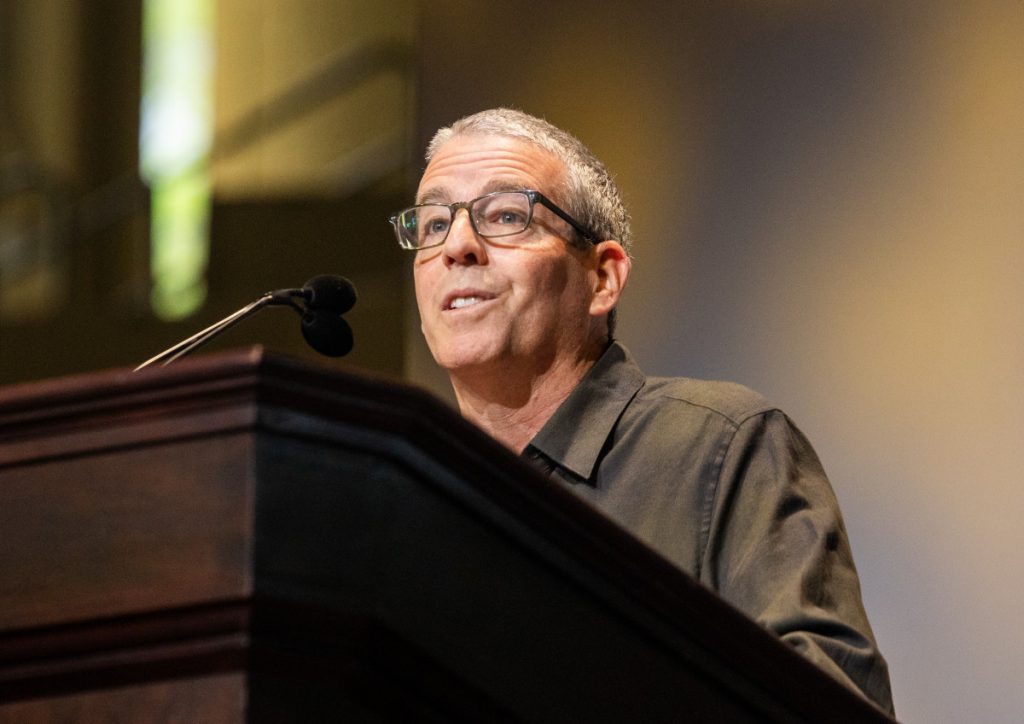
Journalist and author of We Are Eating the Earth: The Race to Fix Our Food System and Save Our Climate Michael Grunwald speaks on the increasing damage agriculture is doing to the environment Thursday in the Amphitheater.
“Beef is the number one driver of deforestation in the Amazon,” Grunwald said. “… When you’re eating a burger, you’re not just eating a cow. You’re eating macaws and the rest of the cast of ‘Rio.’ You’re eating the Amazon. You’re eating the Earth. So this is the challenge, right? To feed the world without frying the world by 2050.”
The last issue Grunwald addressed was climate change. He said agriculture has become riskier due to more intense droughts and floods killing crops and livestock. Simultaneously, pests are invading new regions.
“We probably need wheat yields to increase by a third over the next three decades, but scientists now believe that climate change could reduce wheat yields by a third,” Grunwald said. “No bueno.”
He urged the audience to reduce their food waste and eat less meat, specifically beef. He said, “The average American household wastes $2,000 a year on food that ends up in landfills, emitting methane.” When prices were rising in 2024, he said those numbers didn’t budge.
To alleviate food waste, startup Mill Technologies created a food dehydrator that turns food scraps into chicken feed overnight, minimizing what ends up in landfills. Grunwald said reducing food waste is an issue all parties can agree on, but it will be tougher for the government to lessen meat consumption. In his book, Grunwald quoted a pollster who said: “taxes and other restrictions on meat were literally the least popular policy he had ever polled in America.”
Meat alternatives are not “better or cheaper than meat,” so Grunwald said consumers don’t have an incentive or motivation to purchase them. But he said the technology that helps create stronger alternatives can rise, especially with government help. He said it is possible for the population to eat less beef because there has already been a shift due to chicken prices dropping.
“At the risk of sounding like the ‘Eat Mor Chikin’ cow in those Chick-fil-A ads, that little shift did more to reduce U.S. emissions than any other shift before the rise of solar, and we still eat four times as much beef as the global average,” Grunwald said. “So there’s plenty of room for improvement. So yeah, beef is the baddie.”
From a supply standpoint, Grunwald said there needs to be “even more productive production.” He said regenerative practices, like rotational grazing of their cattle, growing cover crops and practicing no-till, can help to grow more food while requiring less land.
Grunwald said he is hopeful about the future because he sees young people building solutions that are not simply meat alternatives but helping food at every stage, from feed additives that help cattle burp less methane to biotech coatings that prevent food spoilage.
“It is really, really hard to change the world in a hurry, especially the world of food and agriculture, because this stuff is so personal and so political. So we’re going to need political change. We’re going to need technological change. We’re going to need behavioral change,” Grunwald said. “… But if the eating the Earth problem was an easy problem to solve, we would have solved it already.”