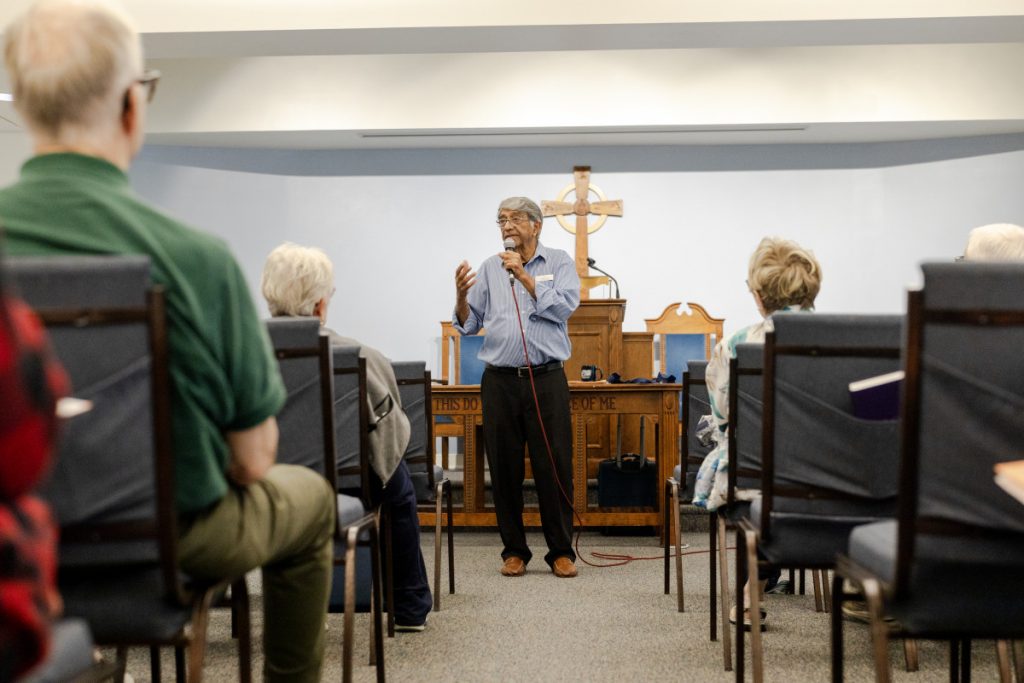
Medical ethicist and hospice physician Dr. Shahid Aziz speaks about end-of-life planning, misconceptions about hospice care, ethics and grief during his class titled “Courageous Conversations on Death and Dying” Aug. 17 in the Presbyterian House Chapel.
LILY RESLINK
Staff Writer
The end of a life calls for deeply personal decisions based on culture, faith traditions, spirituality and what a person believes is a life worth living. Dr. Shahid Aziz, an expert in medical ethics and palliative care, is in the business of fostering communication to pursue more peaceful outcomes with the decisions that accompany this inevitable end.
Aziz will lead this Summer Season’s final session of “Courageous Conversations on Death and Dying” at 3:30 p.m. today in the Presbyterian House Chapel.
To Aziz, conversations about death and dying are worth the courage it takes. He stresses that thoughtful decision-making and communication are essential to reducing unnecessary suffering, both for patients who wish not to be kept alive through “artificial means” and those who must grapple with end-of-life decisions on behalf of their loved ones.
Aziz now devotes much of his life to helping people navigate decisions related to palliative and hospice care because he said he has seen insufficient conversation on these matters become a blockade to finding peace.
“What happens at the end of life stays with you,” Aziz said. “If it’s a nice, peaceful, dignified death and you think about it, it gives you solace. If it’s not, it gives you a lot of aggravation.”
He said his weekly sessions at Chautauqua Institution navigate the topics of advance care planning, lifesaving medical interventions, medical orders, hospice care, palliative medicine, dementia, expediting death, ethics committees, grief and how to approach this subject with children and family.
The session always ends with Q-and-A, and Aziz said he will always stay for however long it takes to answer everyone who has questions.
“If somebody asks a question, I have a story on almost everything,” Aziz said.
Aziz started his career as an academic pediatrician and eventually became chair of the ethics committee.
“I saw all these cases; they all had to do with end-of-life. And I said, ‘Maybe this is where some work needs to be done,’” he said. Aziz documented his journey to identifying this need in the preface of his 2018 book Courageous Conversations on Dying – The Gift of Palliative Care: A Practical Guide for Physicians, Healthcare Providers, & All the People They Serve.
“As soon as people know what I do for a living, they always have a story,” Aziz said.
A man Aziz met in Mexico described how — still, 30 years later — the decision to end his wife’s life-prolonging treatment weighed on him. He said no one had ever rationalized the decision to him, which left him wondering and suffering instead of seeing that her quality of life had already decreased.
“The word I use — which, actually, one of my patients used — is how it was a ‘gift’ to his wife not to let her suffer unnecessarily because she wasn’t going to get anything out of it,” Aziz said.
He said the two conversed honestly about the man’s experience and, through tears and laughter, were able to find solace through dialogue.
He said knowing someone’s answer to “When would you consider life to have lost its meaning?” prevents doctors and families from getting “stuck” in decisions to continue life-prolonging treatments such as medicines, life support machines, artificial nutrition and dialysis in those who lack the capacity to communicate these decisions themselves.
He said if this conversation does not happen in advance, the law dictates that the next of kin is the decision maker. ”If they don’t have any idea what mom or dad or whoever considered a meaningful life, it’s the hardest decision for them to say, ‘Okay, stop prolonging their life.’”
He said he has patients who express confidence that their family will do what’s right for them, but according to Aziz, it isn’t as easy when the time comes.
“I can tell you multiple cases, including a father, a mother, a priest, a minister, and a nurse and a doctor, who, when it came time to make that hard decision, although the right decision, they said, ‘I can make that decision. I know it is the right thing to do, but I can’t do it.’”
He explained how modern medical advancements to prolong lives introduced the need for people to have these “courageous conversations,” because “we became so good at not letting the organs die that even when a person sometimes doesn’t have any quality of life, we can still keep them ‘alive.’”
For example, one of his own determinants for this decision if he is no longer smiling, which he outlines in his book, among other examples of people’s criteria for their “minimum level of meaningful existence.”
Aziz outlined three questions that can help determine or clarify what a person finds acceptable regarding minimum mental function, minimum physical function and life-prolonging treatments. He said, like many decisions, the best way to find a resolution is to “have everyone around the table.”
Maintaining an air of lightheartedness on the topic, he jokingly compared this approach to limbo because he said it essentially asks, “How low can you go?”
He said this is where planning is key. “If you can define where it’s not meaningful in terms of your mental function and awareness, and in terms of your physical abilities, then we know now the time has come not to force you to live the life you don’t want to live,” Aziz explained.
He described that the simplest way to think about this ethical evaluation is to ask how good the decision is for the patient and if it is what the patient would have wanted. He said if it is no longer possible to ask them, the decision-maker should consider “the golden rule” and put themselves in the patient’s position.
Good ethics, Aziz said, “is really not anything more than rational reasoning” and creating outcomes that people see the good in.
He said, “80% of palliative medicine and hospice medicine is guiding people to a path that they feel comfortable with, feel peaceful with and is dignified.”
Aziz credits former Director of Religion Maureen Rovegno — whom he met when he sat next to her at a lecture in the Hall of Philosophy in 2004 — with incorporating his sessions into the Department of Religion’s programs. He said she saw his work as “ministering to the people” and suitable for Chautauqua’s pillar of Religion.
Before connecting with Rovegno, Aziz led Special Studies courses at the Institution, but he was motivated to reach more people. He said with the help of Rovegno and Nancy Bechtolt, they made his first “Courageous Conversations” lecture happen in the Hall of Philosophy in 2011 during a week focused on ethics.
Chautauqua’s platform is meaningful to Aziz because it allows him to reach more people about an approach to medical outcomes where the primary goal is peace.
“There are other people who talk about advance directives a lot,” he said.
His approach of talking about advance care planning takes “the quality of care route” rather than “just the disease and treatment route.” For Aziz, the work is centered on “helping people make rational decisions.” He said, “I’m helping them feel more at peace with their decisions. I’m having the family involved, so … when the time comes, everybody’s at peace that the things are being done.”
Aziz said he does not see this topic as morbid. “It’s just the normal cycle of life. We’re just trying to make that cycle good for you.”
His line of work has put him regularly close to death, including children. He said people ask him, “How come you are not depressed?” Aziz said his answer lies in accepting death and the ability to improve hard times, even if only in small ways. While he said the job can be “very morally distressing,” he described how helping others find peace has also helped him find his own.
“I have accepted the fact that children are going to die. I don’t want it to happen. I don’t wish it on anybody, but it’s going to happen. Now, since I can help those children and their parents and the family get through it — this difficult time — a little bit better, and maybe make the ending a little bit better, then I’m doing something good,” Aziz said.
He said in the field of hospice care, professionals talk extensively about avoiding burnout. For Aziz, finding other outlets to enrich life is important; he cited hobbies, such as sports, that allow him to take a break and step away from his work. As one hobby, he said he picked up the harmonica, which he plays during each Monday session. Amid heavy topics, Aziz incorporates humor and art.
In addition to his musical breaks, Aziz often turns to poetry during his sessions. During his Aug. 17 event,
he read “If I can stop one heart from breaking” by Emily Dickinson:
“If I can stop one heart from breaking, / I shall not live in vain; / If I can ease one life the aching, / Or cool one pain, / Or help one fainting robin / Unto his nest again, / I shall not live in vain.”