
CODY ENGLANDER
Staff Writer
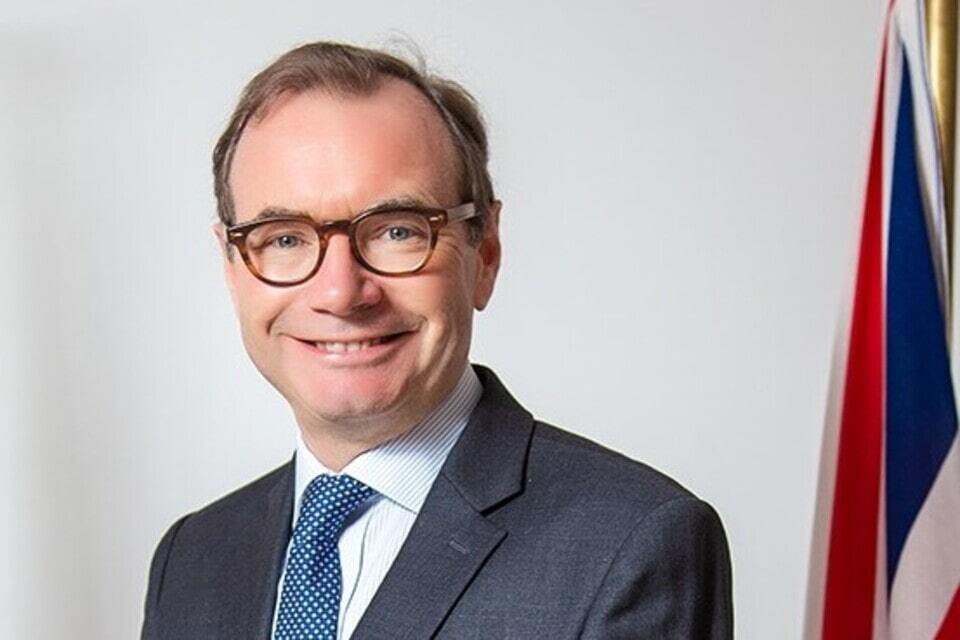
Before his lecture, Robert Chatterton Dickson, an international affairs consultant and a former senior member of the British Diplomatic Service, reflected on a time when the world order changed very drastically.
“I started in the diplomatic service in 1990,” he said. “So, at the end of the Cold War, the Soviet Union actually still existed then, but only just. The Berlin Wall had fallen, and we thought we were into an era, we thought it was the end of history, peace and prosperity, all that. And it felt like a time when the West had won. [We thought] the Western economic ideas were going to be the way to a combined democracy, human rights, rule of law, rules-based international system. It felt then as though that was the only way that society should be organized, and the best way for society to be organized. And I think there was a period of considerable optimism, which really lasted between 1990 and 9/11.”
At 10:45 a.m. today in the Amphitheater, Dickson, an international affairs consultant based in London, will continue Week Seven’s Chautauqua Lecture Series theme, “Global Power and Our Evolving International Order.” Dickson worked in a state of relations within the U.K., U.S., European Union, Russia and NATO. He served overseas as ambassador to the Republic of North Macedonia, consul general in Chicago, deputy ambassador in Afghanistan, high commissioner in Bangladesh and chargé d’affaires of the U.K. Mission to Afghanistan. While in London, he was head of the Foreign Office Counter Terrorism Department and a director in the Cabinet Office National Security Secretariat. Within these roles, he worked closely with American colleagues.
Dickson said he plans to offer the view of a practitioner in terms of today’s discussion about international affairs, which he will be talking about in a strictly personal capacity. He reflected on the changes in the international order and the limits of diplomacy he saw during his experiences.
“I always felt that, however flawed it might be in practice, U.S. international leadership benefited enormously from the fact that its own constitution and arrangements at home were based on [democracy and human rights] principles,” Dickson said. “However flawed they might be in practice, that was a very noble ideal. I suppose I saw the limits of that in Afghanistan. I was in Afghanistan during the war, so from 2013 to 2015, which, in some ways, felt like quite an optimistic period because it did feel as if our great, American-led Afghan project might be sort of going in the right direction.”
He noted a peaceful transfer of power as a major step in the right direction in hopes of a self-sustaining order of governance. However, with the U.S.-backed Islamic Republic of Afghanistan collapsing in 2021, Dickson saw the limits of U.S. diplomacy firsthand.
“Post 9/11, and particularly in Afghanistan, my personal experience was that even the greatest military power and idealism had their limits, and we know with the outcome that we saw,” Dickson said.
While critical, Dickson comes from a place of admiration for the United States, first traveling to the country when he was 19 years old. He also examined the idea that the shifting of the new world order isn’t solely an American issue.
“[Europe has] got a huge demographic challenge, which is actually multiple challenges because we’re running out of people in Europe,” Dickson said. “At the same time, Europe is facing constant threat of uncontrolled migration from elsewhere. So we need more people, but we need them in a controlled way, and that is turning out to be very difficult, and brings a lot of political challenges, including in the U.K. And then clearly, tech is a challenge everywhere, as is demographics, as is climate. But I think for Europe, [it’s] really not part of the tech revolution.”
According to Dickson, Europe has leaned on the United States as an ally for a number of years, but Dickson noted the current relationship as “strained.”
“People who have been the closest partners of the U.S. are busy reconsidering their arrangements,” Dickson said. “So the Japanese clearly, the Saudis, the Gulf monarchies clearly are, but we in Europe are as well, because, [of] direct threats to our allies, as with Greenland, and more or less explicit threats to depart from NATO, at a time when Russia is a huge, very direct threat on our doorstep. You know, that changes a lot, and in some ways, it’s quite healthy for Europe, because Europe was very complacent.”
To Dickson, it’s important to understand that the world changes and having intermediary forces is important to ensure the world has a level of diplomatic security.
“The key thing we need is diplomats, and of course, I would say that because I’ve been a diplomat for a long time. But I think, pulling all that together, what we need is people who can operate in an effective way to generate understanding and outcomes between countries, and sort of make things happen, and are prepared to invest their time in the language skills, and you know, living overseas, understanding societies and working out where and how best to work together.”