ARIANNA NEVAREZ
Staff writer
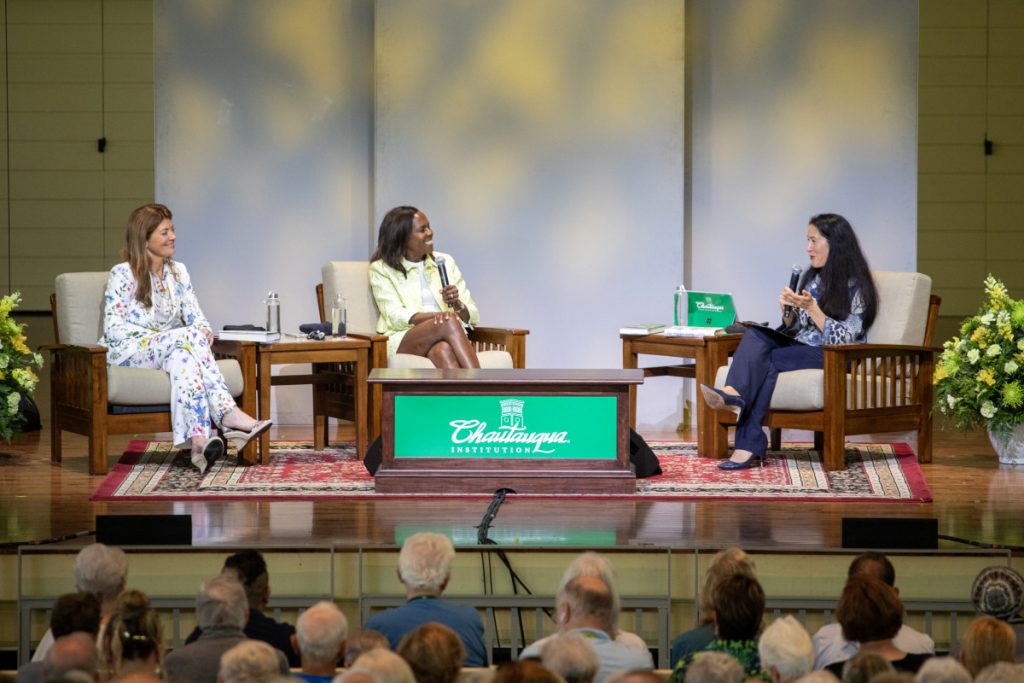
During Week One of “Icons and Instigators: Women Who Change the World,” Norah O’Donnell and Deborah Roberts, two of the most recognized TV journalists, said despite the word’s connotation, women should still be instigators.
At 10:45 a.m. Monday in the Amphitheater, O’Donnell and Roberts opened the 2026 Chautauqua Lecture Series by telling stories about women who have shaped history and explaining how representation can lead to confidence.
The two began the conversation by discussing why now was the time for their recently published books. O’Donnell said the driving factor behind We the Women: The Hidden Heroes Who Shaped America was a combination of the 250th anniversary of the United States and the need for women’s stories and women’s voices to be heard.
O’Donnell said that only 15% of what is taught in U.S. schools highlights the achievements and history of women, according to the National Women’s History Museum, but knowing about these women’s stories and struggles in her early education could have changed her perception of herself and what women could accomplish.
“The truth is that women have been at the forefront of American history and all the great moral and political struggles,” O’Donnell said. “They have not been a footnote. They have been the driving force behind change.”
Roberts said her book, Sisters Loved and Treasured: Stories of Unbreakable Bonds, was inspired by her own experience with six sisters. She said she believes sisterhood can push humanity forward and cited recent scientific research backing the importance of these relationships.
“There are actually studies now that show having a strong woman, or particularly sisters in your life, will boost your well-being and your optimism and your sense of self,” Roberts said. “So I thought, ‘Let’s explore this and let’s do it through the lens of how you grew up, what foundational background was like, but also how that plays in your life and can lead to these kinds of accomplishments.’”
The pair discussed women who they see as having changed the world, from Viola Davis to Lee Woodruff. O’Donnell recognized that there are many sisters in her book who are historical figures, such as the Blackwell sisters — the first female doctors in America, who founded a hospital — and the Grimke sisters, who became noted abolitionists and speakers.
O’Donnell emphasized a particular “instigator,” Dr. Mary Edwards Walker, who was one of the first women to graduate from medical school and an aid in the Civil War. When she first requested to serve, she was denied, but she went regardless to help take care of the soldiers and was captured by the Confederacy. Upon her release, President Abraham Lincoln awarded her a Medal of Honor, the only one awarded to a woman. Later, the U.S. Army and Congress tried to take away the medal, but she refused to give it back and wore it every day until the day she died.
“I tell that story because, as an instigator, she was told no. And she said, ‘Yes. I will fight for my country, even risk my own life to do that,’ and that is the story,” O’Donnell said. “Those are women’s stories in history that I did not learn about and changed the way I think about so many things.”
O’Donnell then discussed how these women’s stories are missing in education. She said she put “hidden heroes” in the title of her book because there’s usually a woman in the story who was left out of the history book. For example, the pair pointed out Katharine Wright Haskell, the sister of the Wright brothers, who is rarely talked about. Yet, President William Howard Taft called her the “most important member of the family.”
“These women were coming up during times where they couldn’t really assert themselves, but today you really can,” Roberts said. “I think it’s about realizing what you have inside. And if nothing else, hopefully women and young girls will have that inspiration after reading these stories and realize that they can be their own figures and not-so-hidden figures. They can lead to other figures that are boldly discovered in our midst.”
As journalists, they spoke about how they center women within the stories they report on. Roberts said she naturally gravitates toward telling stories about women. She also said, unfortunately, at “20/20,” women are victimized in the stories she tells, but she ensures the whole story is told and in a “dignified” way.
O’Donnell said she looks at CBS’ coverage and asks herself, “Where are the women in this story?”
When she joined “CBS Mornings,” she started a series called Profiles in Service, which focused on women in the military. As she continued her career, she said she ensures women are still at the forefront of top stories to ensure representation.
“I always try and pick up the women in the stories that we cover because stories shape culture. Culture shapes our community. Our culture and community allows our children to dream of what they can become and who they can be, and it gives them confidence, so elevating these stories is how we change culture and community.” O’Donnell said.
Both Roberts and O’Donnell mentioned Barbara Walters as the woman they look to who paved the way for the future of journalism. O’Donnell said representation can lead to more women dreaming of bigger futures and careers for themselves, just as Walters did for them. Roberts acknowledged other trailblazers, like Susan Zirinsky and Meredith White, that came before her, but she said this trend of women in news has lost traction.
“We’ve lost women in so many industries now,” Roberts said. “So I do whatever I can to encourage young women, particularly interns, who come into our sphere at ABC News. I think it’s really important for us to step out there and encourage the next generation just as those who came before us encouraged us.”
Roberts and O’Donnell closed their conversation on the Amp stage by talking about Generation Z. O’Donnell said that young women are fearless and open about pushing for the things they want. Roberts also sees that they are demanding what they believe they deserve, but she worries they feel all of the battles have already been fought by women of the past.
“I think that they feel that we’ve done a lot of that work … but you can’t walk out and sort of assume these roles, and that’s not always the case,” Roberts said. “So, I want to see young women recognize their power but also recognize that they have to continue to fight.”