CODY ENGLANDER
Staff Writer
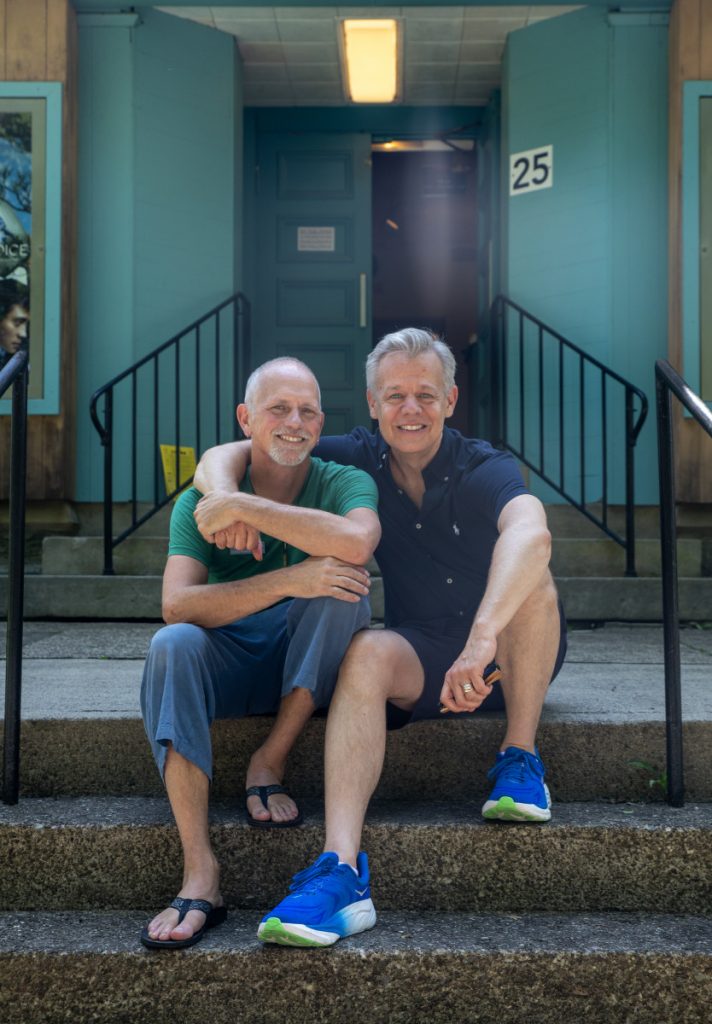
Filmmaker and sixth-generation Chautauquan Daniel Karslake recalls the time he came out to his parents.
“I knew I was gay, so I told them, and they would recite Bible verses to me,” Karslake said. “This was hard enough already and I told them, ‘If you can’t be civil and stop doing this, I don’t want to talk to you.’ And that lasted two hours until my dad called me back.”
This resulted in a brief period of familial division, a core theme in his newest documentary “It’s All the Rage!” The director, writer and producer will bring the documentary to Chautauqua Cinema for a 4:45 p.m. trial screening today.
“It’s All the Rage!” focuses on four individuals through the modern political division in America, driven by news outlets and social media. The inspiration for the documentary came from a place originating very close to Karslake. The screening will contain three extended clips from the documentary, soliciting feedback from the audience.
“I come from a politically divided family,” Karslake explained. “I’m on one side of the spectrum, and my parents are way over on the other side, and that’s been very, very hard on my family, because more and more in our bubbles, algorithms are telling us that we can’t have anything to do with [people on the other end of the political spectrum], that these people believe crazy things.”
Karslake has seen the rise of political division in the country from afar, having lived in Berlin with his husband since 2014. He observed the 2016 election as one of the main catalysts for the country’s modern political landscape.
“It’s almost unrecognizable the way that politicians talk about each other, and the way that Americans talk about each other. Because I wasn’t in it, I was able to watch it from outside,” Karslake said. “My parents were in it, all my friends were in it, they felt it happening. I think it felt much more extreme to me, because I was watching it from the outside.”
Then, during the pandemic, Karslake read High Conflict by Amanda Ripley, where he got the inspiration for “All the Rage!”
“Ripley had these real life examples of other countries and smaller groups within America which had been able to move past the polarization and not only tolerate each other, but become friendly again,” Karslake said.
He met with Ripley, a prior lecturer at Chautauqua Institution, about making a documentary evoking ideas from her book, hoping to bring out a visualized idea of togetherness which Karslake has seen become increasingly rare.
“Every study says that Americans across the political spectrum agree on almost everything, but because the people on the fringes on either end are the loudest, they’re the ones that get covered, they’re the ones that cause clicks,” Karslake said. “… That has convinced Americans that we are way too far apart to ever come together again. The irony is, it’s not true. We are actually so we have so much more in common than we know.”
For Karslake, developing these ideas through the medium of film is important for a general audience. Film had spoken to him from a young age, when he first watched “Willy Wonka and the Chocolate Factory” at the Chautauqua Cinema. He attended all six showings of the movie that summer.
Later, when he was living in New York after film school, he attended a showing of Michael Moore’s documentary, “Bowling for Columbine,” the motivation behind Karslake’s first feature documentary, “For the Bible Tells Me So.”
“I was thinking about how strategic [Moore] was, and 20 minutes in, I thought, ‘I need to make a film about religion and gay people like this,’” Karslake said. “I stopped watching the movie and just sat there, thinking, ‘I’ll ask this theologian, because I’d met all these theologians.’ I missed the rest of the film, so when I left the movie theater that day, I went straight to the box office and bought another ticket. That was the catalyst for me.”
Not only experiencing the power of film, but also having the power to bring a real response out of an audience is part of what draws Karslake to storytelling as a whole. Before making his feature, Karslake worked as a director and producer for PBS’ “In the Life” and saw the power his stories had firsthand.
Karslake wanted to develop a story that followed Christians who interpreted the Bible differently than other sects of Christianity. The executive producer originally rejected the story due to the topic of religion, but Karslake convinced him that the story wasn’t about denigrating Christians, but a story about Christians welcoming the gay community. The special aired and netted “In the Life” the show’s first Emmy nomination.
“There were 50 to 60 messages from people who had seen it the night before across the country. The very first message I opened was from a 12-year-old kid in Iowa. It was five lines. ‘Last week I bought the gun. Yesterday I wrote the note. Last night I happened to see your show on PBS. Just knowing someday somewhere I might be able to go back into my church with my head held high, I dropped the gun in the river. My mom never has to know.’ That email, it changed everything for me.’”
Karslake intends to channel the power he was able to capture in his previous works in his newest project, hoping to bring some form of togetherness back to America, no matter the scale. For Karslake, there is hope in the world; people just need to find it.
“I know my parents, I disagree with their side of the political spectrum, but I know they’re good people. They’re not stupid. They’re highly educated. All the stuff that I’m told my parents are because of who they support is wrong,” Karslake said. “… There’s hope, and that’s what my films are ultimately about. The goal is to make people hopeful again.”