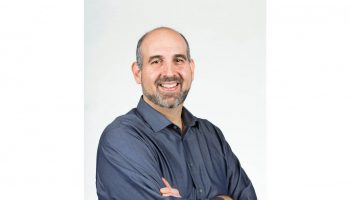
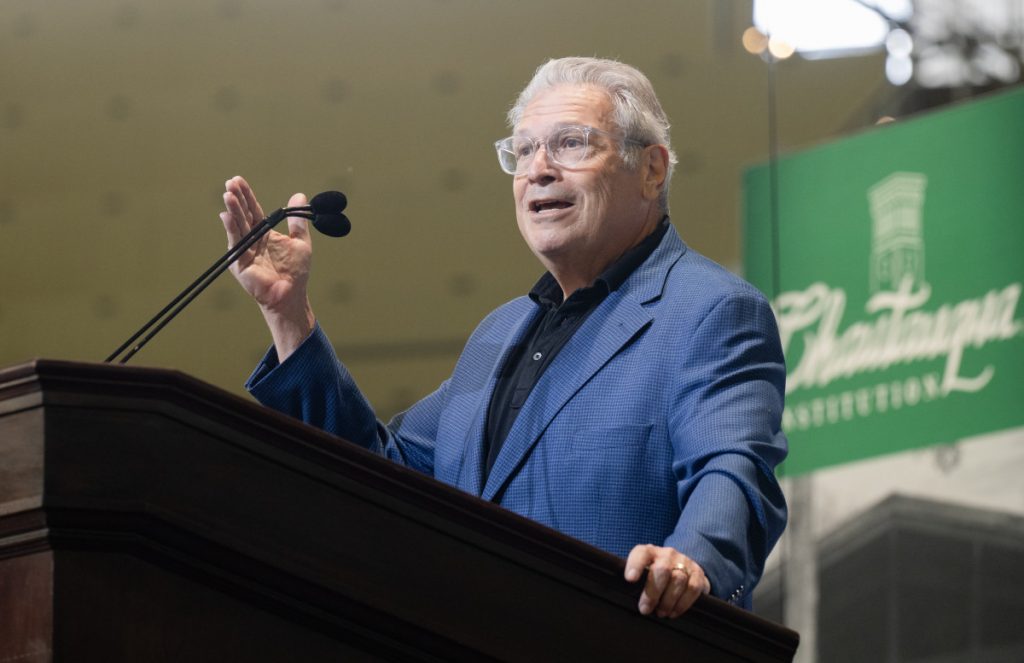
Brookings Institution Senior Fellow Robert Kagan shares his perspective on the state of the current world order Friday in the Amphitheater.
LAYLA VINSON
Staff Writer
Brookings Institution Senior Fellow and contributing writer to The Atlantic Robert Kagan discussed the haunting ghosts of foreign policy’s past, present and future in his morning lecture at 10:45 a.m. Friday in the Amphitheater in alignment with Week Seven’s theme, “Global Power and Our Evolving International Order.” Kagan centered his discussion on the precarious nature of world order throughout history, the human tendency to overlook developing issues and anticipated consequences for the United States as it sunders ties and influence abroad.
“It’s a hard thing for human beings to recognize rapid change when it’s happening, especially when we’ve been living in a period that had been relatively peaceful, relatively prosperous, for a long time,” Kagan said.
He emphasized the poverty, tyranny and constant threat of major war that loomed over the majority of humanity up until 1945. “We get used to the idea of incremental change. Yes, this is getting worse, this is getting better, we (have) got to address that, et cetera. I want to suggest we are now in a period of radical and rapid change, because when a world order collapses for whatever reason, everybody has to reconfigure themselves.”
In Kagan’s eyes, the impending collapse of world order has been brought about by the systematic and deliberate destruction of longstanding tools, mechanisms and institutions best equipped to meet the major challenges of contemporary times.
“By destroying our alliances, by tariffing our allies, by making it clear that the United States is not interested in protecting others — that we’re really only in it for ourselves and the money that we can make — we are destroying a system which really proved to be a remarkable period in world history,” he said.
Looking to nations within past multipolar world periods, Kagan stressed the constant threat of war that plagued each country that could not look for security outside of itself. As each country viewed the other as an enemy, alliances frequently shifted, creating a highly disruptive society. But Kagan said under Roosevelt and his generation, the U.S. sought to escape this multipolar world in their creation of the American world order after World War II.
“What happened in that period was really historically unprecedented and almost impossible to believe, because if you think about the World War II settlement, look at all the major great powers within the source of conflict amongst themselves for centuries who, all of a sudden, gave up those great power ambitions,” Kagan said.
He specifically highlighted nations such as Britain, France, Germany and Japan, which allowed themselves, some initially involuntarily, to be encompassed under the American security umbrella.
Kagan explained that in entrusting their fundamental security to the U.S., these great powers entered a critical bargain. According to Kagan, the heart of this bargain centered on the expectation that the U.S. would garner the power necessary to provide protection, establish an international economic order focused on values of free trade and refuse to abuse that power to bully its allies.
“Trust. Trust was the most important element of what made that system work,” Kagan said. He said he believed one reason the U.S., despite its imperfections, was deemed trustworthy by other nations was because of its spirit of generosity and motive to create a stable system where they would not be drawn into another world war. “… We have now moved into a different posture. Now we have a national security strategy that says we’re going to be focused on the Western Hemisphere.”
Listing recent examples of the invasion of Venezuela for its oil and tariff policies for money and power, Kagan said the U.S. has now taken advantage of the bargain struck among allies to exploit their weaknesses and take their money.
“[The United States is] basically making it extremely clear that [it] will not protect [its allies] in the case that they are attacked. I don’t think [its] Article 5 commitment to NATO means anything anymore,” Kagan said, referencing the core collective defense commitment of the alliance. “And I’m sure that the Europeans don’t think that it means anything anymore, which is why they are rearming. They’re not rearming because Donald Trump has convinced them of the importance of burden sharing. They are making the army because they are scared to death.”
Kagan evaluated an amassing German military — specifically, plans to borrow more than $800 million in loans for rearmament — as a prominent manifestation of this apprehension. Breaking decades of fiscal restraint since its reunification in the 1990s, the budget marks a sharp turn from the country’s longstanding aversion to debt, according to The Luxembourg Times.
“We can hope that the Germans maintain this, I would say, benevolent view of what the role of their power should be. But, let’s not forget … the second largest political party in Germany is the AfD, which is a right-wing — vaguely at some fringes — neo-Nazi party,” Kagan said.
Kagan cited his six years spent living in Europe where he claimed to have witnessed surprisingly prevalent underlying tensions between countries and residual distrust in Germany.
“[The AfD] is now the second-largest party in Germany right now. So we are all playing dice with this situation, and so the future of Germany, it seems to me, is potentially complicated. And I would say that if we are, in fact, as it seems we are, moving into a world in which the only security you have is that which you can provide yourself. I think Germany, in that context, is going to become one of the great powers of the world as it had been in the past.”
Kagan warily noted the perceived faces of nations such as Germany and Japan as “liberal, democratic, vaguely half pacifist, just trying to make money and not make trouble,” stating these have existed while living under the American security umbrella. Kagan further theorized what might happen to the character of these countries when made to defend themselves, claiming history suggests their faces may change in more turbulent times.
“You have to think that not only are relative powers going to change around the world, but the very character of these countries, the very character of their regimes, may change in the process,” Kagan said. “Power does things to nations, as the American people can attest, and I think that is something that we have to worry about. And after all, the idea that a nation shows more than one face to the world is now clearly true about us.”
Forecasting an increasingly grim future, Kagan expressed the dimming likelihood of salvaged trust in the U.S. Noting the direct actions of the U.S. as leading to the closing of the Strait of Hormuz, Kagan feels this failure will only garner more discontent from countries abroad.
“I suppose right now that the most optimistic scenario that I can think of is that, eventually, the American people will wake up and realize what is happening and maybe demand a reversal in this approach to foreign policy,” Kagan said, urging audiences to protest and avoid complacency. “… Make it clear that you’re unhappy about this direction, you can tell your members of Congress. Don’t wait for the next crisis to wake up. We can see the crisis coming, history tells us the crises are coming, and it’s time for us to turn things around right now.”