
LILY RESLINK
Staff Writer
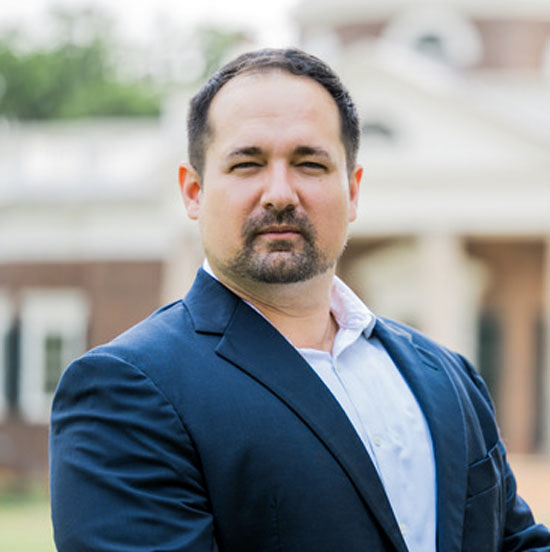
Brandon Dillard spends his career as a historian in the public eye, serving as the director of historic interpretation and audience engagement at Thomas Jefferson’s Monticello — where he learns not only about the formative politics of the past, but how best to communicate historic knowledge across the diverse political affiliations of today.
At 2 p.m. today in the Hall of Philosophy, Dillard said he will look at Monticello’s approach to the 250th anniversary of the Declaration of Independence in a moderated conversation with Director of Religion Robert Wilson-Black.
In line with the theme of Week Six’s Interfaith Lecture Series, “A More Perfect Union: Faith, Memory and the American Promise,” Dillard said his conversation comes from his lens of how Monticello, Jefferson’s plantation home that is now a UNESCO World Heritage Site, has prepared its public programming for the 250th.
Dillard said the conversation will likely focus on “how to talk about Jefferson’s legacy, what it means in terms of civic renewal and democracy in this moment and then, of course, conversations around [Monticello’s] approaches to interpretation and how to tell truthful, honest histories in a moment of extreme partisan division.”
He said Monticello’s evaluation shows an even split in the political beliefs of patrons, which, according to Dillard, aligns exactly with Monticello’s mission.
He said people of mixed political backgrounds gathering in a space for the same reason is an increasingly rare occurrence in American society, and Monticello’s evaluations show that most people, regardless of political affiliation, are interested in having complex discussions about the past and hearing about aspects of the past that may be at odds with their partisan beliefs. Dillard said his background in practical research has been evaluative, which he has applied to his 16 years working at Monticello.
“We look at how approaches to conversations are received by audiences, and we look for commonalities where people who hold diverse political perspectives might be sort of brushed off as not having them,” he said.
Whereas much research is driven by understanding the past, he said Monticello’s research is driven by shaping an approach to education that prompts individuals to ask themselves how they can best understand the past.
Working at Monticello, he said, has revealed positive trends in people’s educational inclinations in the U.S.
“I think Americans broadly agree far more than they disagree, which is something that, especially right now, feels completely at odds to how most of us feel.”
Regarding how the conversation might connect to the Interfaith Lecture Series, Dillard said the discussion will likely explore Jefferson’s unique religious perspectives, as well as how Monticello engages with audiences who come to Monticello with broad preconceptions of Jefferson’s religious practice.
“Jefferson was an uncommon man in so many ways, and especially in the way he approached his own personal faith, about which he was quite guarded,” Dillard said. “He was very much somebody who — maybe more than any of the founders — advocated so strongly for the spiritual church and state and the freedom of religion that we enjoy in this country today.”
Dillard said he has encountered audiences who both come to Monticello with understandings of Jefferson as an atheist and some who come with understandings of him as an Evangelical.
“Neither of those things are exactly accurate, but we want to be able to reach people where they’re coming from and help them complicate every perspective,” he said. “The intent is to welcome complexity and to welcome nuance.”
Dillard is currently a Ph.D. student at University of North Carolina at Chapel Hill, where he is working toward a doctorate in American Studies with a focus on public history and Indigenous memory in the United States, to which he said he brings a “nontraditional” approach.
“I have had a 17-year career in public history before attempting to get this doctorate degree,” Dillard said. “I think that practical approach informs the way that I discuss these topics with public audiences.”
At some point during the conversation, he said he expects to discuss his own perspective as a Cherokee Nation citizen who studies public memory. He said, “I spend a lot of time thinking about Indigenous ways of knowing and looking at this anniversary as well,” he said. He acknowledged his perspective on the difference between how research historians talk about the past and how public historians engage with public audiences about the past.
In reference to Monticello’s approach to historical interpretation as “empathetic and emotive,” he said this empathy must extend to the audience, the historical figures being discussed and change over time.
“The emotive quality is that there’s nothing wrong with people having emotional responses to hard conversations or to inspiring conversations,” Dillard said.
He acknowledged how the work of academic historians informs the ability of public historians to effectively communicate learned knowledge.
“Without academic historians, obviously, I can’t do the work that I do, but … ( I )think that the goal is to have a more off-the-cuff discussion when I can, and I think that [today’s Interfaith Lecture Series program] is going to provide an opportunity for that,” Dillard said.